Food note
The kipper: a herring split, salted and smoked over oak
Not a species and not a recipe but a method: split, brine, hang, and cold smoke until the fish keeps.
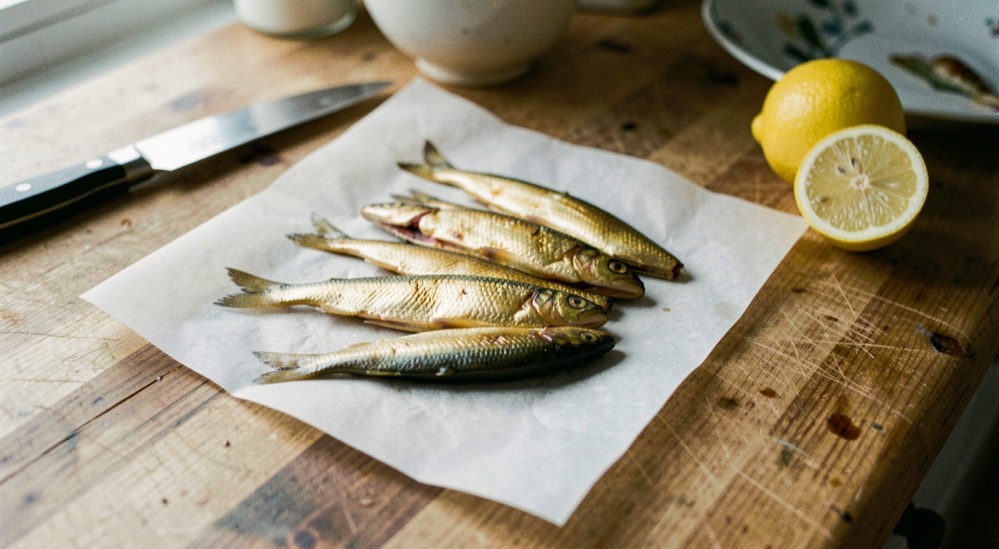
A kipper is a whole herring, split butterfly-fashion from tail to head along the dorsal ridge, gutted, salted or pickled, and cold-smoked over smouldering wood chips, typically oak. This note follows the fish through the word, the cure, the colour and the plate, and asks what the herring itself was to the shore between Staithes and Robin Hood’s Bay. It sits with the other food notes for this coast.
Where the word comes from
The word is thought to derive from the Old English cypera, related to copper and the colour of the fish. The parallels are less tidy: Icelandic kippa, to pull or snatch; kippen, to tilt or incline; a Middle English kipe, a fish basket. One further theory traces the word to the kip, the small beak that male salmon develop in the breeding season. As a verb, to kipper meant rubbing a fish with salt or spices and drying it in the open air or in smoke, a cure since stretched to poultry, beef and other meat. None of the derivations is settled.
Was the kipper an accident?
The exact origin is unknown. Seahouses, in Northumberland, is one of the places where kippering herrings is said to have begun, and the stories attached to it are all accidents. Thomas Nashe wrote in 1599 of a fisherman from Lothingland, near Great Yarmouth, who found his herring smoked by mischance. In the other tale, set in 1843, fish left overnight in a room with a smoking stove came out cured, to the credit of John Woodger of Seahouses. Smoked foods almost always carry such legends. What is certain is duller: slitting, gutting and smoke-curing fish is well documented, whenever it started.
Split, gutted, cold-smoked
Three smoked herrings share the counter; the difference is the work done before the smoke. A kipper is split, gutted and cold-smoked; a bloater is cold-smoked whole; a buckling is hot-smoked whole. The split is the point rather than the butchery: butterflying or slicing exposes the maximum surface area to the salt and the smoke. The fish suits the method. Oily fish take smoking better than lean ones, because the oil spreads the heat evenly and the flesh resists flaking, and the herring is a small, oily fish.
Why are some kippers orange?
A kipper is sometimes called a red herring, though a truly red one demands a particularly strong cure. The bright colour most plates now carry began as a wartime economy. Dyeing was introduced in the First World War to avoid the long smoking process; the fish could be sold quickly, easily and at a substantially greater profit. The first dye was a coal tar product called brown FK, the initials standing for “for kippers”; European Community legislation now limits its acceptable daily intake to 0.15 mg/kg. Today the brine usually carries annatto, a natural dye giving a deeper orange or yellow colour, and mature fish take the dye better, their denser flesh absorbing it. Kippers from the Isle of Man and some Scottish producers are not dyed; the smoking time is extended instead, in the traditional manner. The colouring story, dye by dye, is in the kipper entry.
Red herring, in old ink
The phrase has a long paper trail. In a mid-13th century Anglo-Norman poem, Walter of Bibbesworth gives one diner the line “He eteþ no ffyssh But heryng red”. Four centuries later, on 28 February 1660, Samuel Pepys opened his diary with the same fish:
Up in the morning, and had some red herrings to our breakfast, while my boot-heel was a-mending, by the same token the boy left the hole as big as it was before.
Breakfast first, the complaint about the boot-heel alongside, and no dye in sight. The orange kipper is the newcomer at a very old table.
What the herring was to this coast
Whitby stands at the mouth of the River Esk, where the North York Moors come down to the sea, and from the Middle Ages it kept significant herring and whaling fleets. Under Elizabeth I it was still a small fishing port; in 1635, twenty-four burgesses held the privilege of buying and selling goods brought in by sea. The herring were here. The kipper’s famous addresses, on the entry’s evidence, are elsewhere: Seahouses and Craster in Northumberland, Mallaig once the busiest herring port in Europe, Stornoway, Loch Fyne, and Peel on the Isle of Man, where two kipper houses founded in 1882 and 1884 smoke and export fish by the thousand. This desk leaves firm names out of its pages; the entry carries them. What this coast did next with its fish is taken up in fish and chips on this coast.
From breakfast to idiom
Cold-smoked fish that have not been salted for preservation must be cooked first, boiled, fried, grilled, jugged or roasted. In the United Kingdom the plate is usually a breakfast plate, though the habit has declined since the Victorian and Edwardian eras. Before the Second World War, kippers, with the bloater and the buckling, were a high tea or supper treat, most popular among inland and urban working-class households. In the United States it survives mostly as canned “kipper snacks”, precooked. The word has travelled further than the fish. Kipper time was the close season for salmon in the River Thames, fixed by an Act of Parliament at 3 May to 6 January; kipper season, among fairground, market and taxi workers, is the lean first months of the year. To be “stitched up like a kipper” is to be used or framed past mending. And in The Railway Series the Flying Kipper is the fast fish train usually given to Henry the Green Engine.
The fish on the plate
A kipper, then, is a whole herring, split from tail to head along the dorsal ridge, gutted, salted and cold-smoked over smouldering oak chips, and it belongs chiefly to the breakfast tables of the United Kingdom and Ireland. It is still smoked at Peel and Mallaig, at Craster and Stornoway, and exported around the world from the Isle of Man. On the plate its colour is its history: a deep orange or yellow points to annatto in the brine, and a fish left its own colour points to a smoke given longer to work.