Food note
Sloes on the coastal path, and what they were for
The last wild harvest on this shore: a bitter plum, a spiny hedge, and the uses a farming coast found for both.
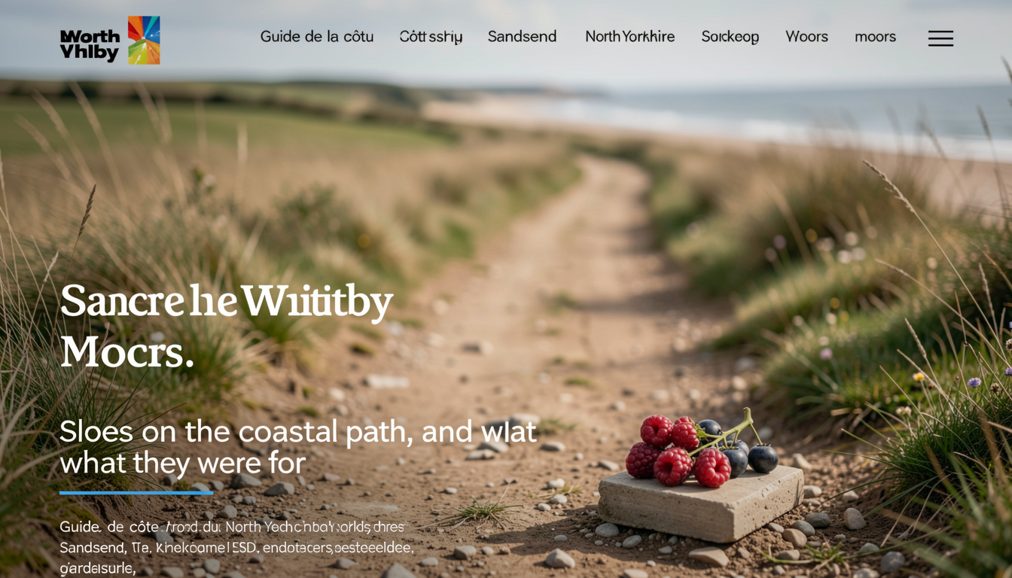
In October the hedges above the cliff path turn black with fruit. The blackthorn, the same spiny shrub that furred the wayside white in March, hangs its sloes along every sheltered length of hedge between Sandsend and the bay to the south. They are among the last wild things a walker can still pick on this coast, and they come with a use that has not quite died out.
What the blackthorn is
Blackthorn, Prunus spinosa, is a native shrub of hedgerow and scrub, thorned enough to stop a sheep and tough enough to hold a bank. It flowers before its leaves open, which is why the blossom reads as white smoke along a bare hedge in early spring. The fruit follows in autumn: a small blue-black plum, round as a marble and so sharp on the tongue that nobody eats it raw twice.
On this coast it grows where the wind lets it, which means the tops of the cliffs and the sheltered lanes a field back from the edge. The thicket it makes is not decoration. It holds nesting birds in spring, shelters the hedge bottom from stock, and in a hard winter its roots are part of what keeps the field edge standing.
Why the fruit was ever picked
The sloe is useless on the branch and valuable off it, which is the kind of paradox a farming village understands. Gathered after the first frost has burst the skins, the fruit goes into gin for steeping, into jam pans with apple to set, and into jars for a rough country wine. The tradition of making wine from hedgerow fruit is the same craft in a different vessel: sugar, time and a dark corner turn an inedible berry into something worth keeping.
What the hedge gives is free, but it is not casual. Picking sloes means thorns, stained fingers and the patience to take the fruit frost by frost rather than all at once. The old rule of waiting for the first frost was practical before it was picturesque: cold splits the skin and starts the work the sugar finishes.
Where the path gives and where it does not
The forager’s rule on this coast is the same as the walker’s: take what the ground offers in passing, and leave the ground as it was. A handful of sloes from a hedge on a public path is an old liberty; stripping a hedge is not. The cliff path between Sandsend and Whitby passes long lengths of blackthorn, but the best picking is usually a field inland, on the quiet lanes where the hedge is taller than the wind.
Timing matters more than location. A warm autumn pushes the fruit early; a wet one rots it on the thorn. The old advice to wait for frost is now often adjusted to a night in the freezer, which does the same work in a milder century.
What else the autumn hedge gives
The sloe shares its season with the haws of the whitethorn, the last blackberries and the hips of the wild rose. All of them went into the same farmhouse economy: preserves and cordials that stretched the summer into winter. The practice survives less as need than as habit, and the habit survives because the hedge still sets the table.
The same season reshapes the coast itself. The old alum terraces north of the village carry their own scrub, and the blackthorn that colonises a spoil heap is doing the first work of holding it.
Do the sloes still matter?
As food, barely. A jar of sloe gin is a winter ritual now, not a provision. As a marker of the year, they matter more: the blackening of the hedge is one of the few remaining signs by which a walker can read the season without checking anything. And as a piece of the coast’s structure, the blackthorn matters most, because the thicket is still working whether anyone picks from it or not.
There is a final use nobody planted it for. The blackthorn thicket is the coast’s informal larder of shelter: rabbits burrow under it, warblers nest inside it, and the winter thrushes strip the berries the pickers missed. The hedge works for the shore whether or not anyone ever takes a sloe home.
The spring display deserves its sentence as well. Before the leaves, before the blackthorn’s own leaves, the hedges go white in March, and the old weather lore ties the blossom to the blackthorn winter, the cold snap that follows the flowers. The shrub marks the year twice, in white and in black.
What is the blackthorn hedge, then?
It is the coast’s commonest piece of living boundary: a spiny shrub, planted or self-sown, that holds a bank, shelters birds and pays an autumn harvest of bitter fruit. What remains of it today is nearly all of it, which is rare on a shore where so much else has been quarried, closed or carried away.
A neighbouring note follows the thread: the sea state that decides every shore day.
The same arithmetic applies further along the path. A house at Sandsend carries a premium for the view, and the paperwork behind it is familiar: a solicitor, a search, a stamp duty bill. Buyers looking at property abroad meet a different sequence of steps, and the questions German buyers tend to ask about buying a house in Poland, from notary fees to land rules, are set out plainly in this guide to Polish property. The cliff path here is free to walk. Buying the house at the end of it is not.
Sloes are not the only fruit that asks for patience before it is useful. On the Aegean coast, cooks treat the season the same way: they buy what the market has that morning, then wait for it to soften, salt, or dry before it reaches the table. A pension kitchen there works with one gas ring and a few pans, much as a Sandsend kitchen works around a single harvest. The same plain rule holds on both coasts: the fruit decides the timing, not the cook. Aegean coast cooking sets that out in more detail.