Food note
Fish and chips: how a fishing port ended up eating them
Fried fish from one tradition, chipped potatoes from another, joined in the nineteenth century and carried inland by rail.
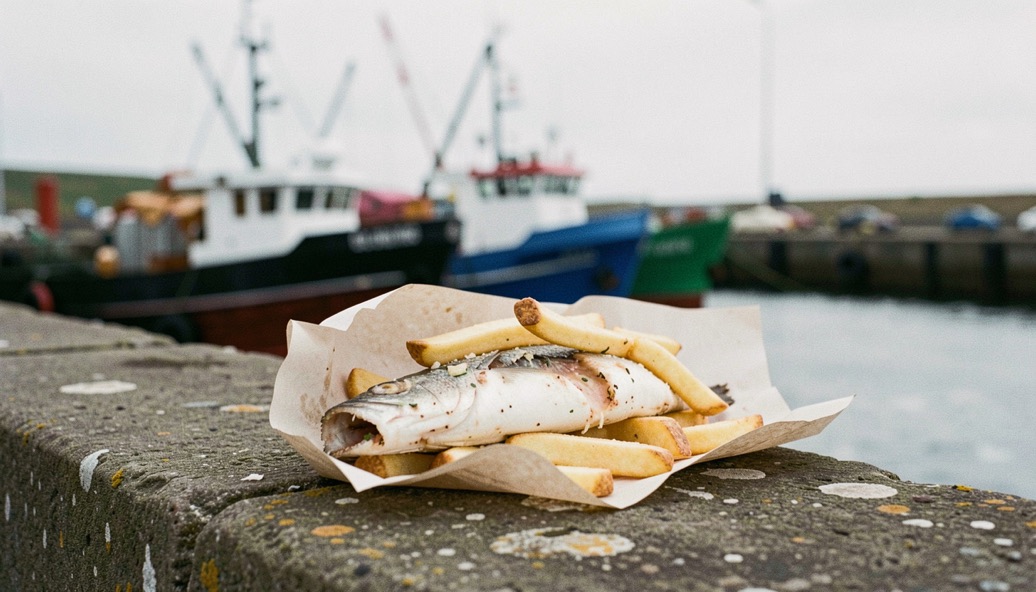
Fried fish came to England with Jewish immigrants who had lived in the Netherlands, chips were a separate northern trade, and the two met only in the 1860s, in London or in Lancashire; the records do not settle which shop was first. This note follows each half to that meeting, then along the trawlers and railways that made the pairing a working-class supper, and names the fish that sits under the batter here.
The tie to this shore is material rather than decorative. Whitby had kept herring and whaling fleets since the Middle Ages, and its first railway, opened in 1839 with horses on the level and cables on the inclines, was an early piece of the joining of ports to industrial cities. The dish fed on that joining.
Fried fish arrived with the Jewish communities
Frying fish in oil came to England with the Chuts and with Spanish and Portuguese Jews who had lived in the Netherlands. Some arrived as early as the sixteenth century; the main immigration to London came in the 1850s. Their fish was fried like pescado frito, floured and cooked in oil, and made for Shabbat, so that Friday’s frying could be eaten cold the next day; olive oil, rather than a hard fat such as butter, kept it palatable.
Charles Dickens put “fried fish warehouses” into Oliver Twist in 1838. In 1845 Alexis Soyer gave a recipe for “fried fish, Jewish fashion” in A Shilling Cookery for the People, the fish dipped in a batter of flour and water. In most English cookery books, though, “fish the Jews’ way” meant escabeche, fried and pickled in vinegar.
Where were the two trades first put together?
The location of the first shop is unclear. The earliest known ones opened in the 1860s: Joseph Malin, an Eastern European Jewish immigrant, traded in Bow, East London, around 1860, and a Mr Lees sold in Mossley, Lancashire, by 1863. Later came the plaques: the National Federation of Fish Friers called the London shop the first in the world, and a blue plaque marks the Oldham claim.
The date matters less than the arithmetic behind it. Fried fish and chips had each existed on their own for at least fifty years. An earlier combination, somewhere, cannot be ruled out.
Trawlers, tracks and a spreading counter
The meal moved inland on rails. Trawl fishing developed quickly in the North Sea, and railways laid from the ports to the industrial cities in the second half of the nineteenth century let fresh fish reach them fast; a stock meal of the working class was the result. The local survivor of that network is the Esk Valley line, completed in 1865, joining Whitby to Battersby, where lines ran on to Northallerton and Middlesbrough.
The shops multiplied with the industrial population. The full record of the dish and its spread fills more than one note; three counts give the shape of the curve. Both the rise and the fall were steep.
| Year | Fish-and-chip shops in the UK |
|---|---|
| 1910 | more than 25,000 |
| 1930s | more than 35,000 |
| 2009 | about 10,000 |
Why did two world wars spare it?
In both world wars the British government safeguarded the supply; the dish was one of the few foods not subject to rationing. John Walton, the historian of the trade, put the reasoning plainly: “The cabinet knew it was vital to keep families on the home front in good heart, unlike the German regime that failed to keep its people well fed.” Churchill called the pairing “the good companions”, and George Orwell, in The Road to Wigan Pier in 1937, counted it chief among the home comforts, a panacea for the working classes.
Friday keeps an older reason. The Roman Catholic habit of fish instead of meat on Fridays, above all in Lent, outlasted the rule itself, and Friday night remains the traditional night for the meal.
Haddock in the north, cod in the south
In Britain and Ireland the fish under the batter is usually cod or haddock, and the split follows latitude: haddock is generally preferred in the north of the UK, cod in the south. A shop selling several fish by name may also fry lemon sole, pollock, plaice, skate or huss, the last also called rock salmon, a name covering several species of dogfish. Where a menu says only “fish and chips”, the fish is increasingly pollock, the cheaper option.
Labelling tightened in 2003: fish must now be sold under its commercial name, so “cod and chips” stands where the vaguer phrase once did. Herring, the catch this coast is tied to, took the other path: it was split, salted and smoked over oak rather than fried. The note on the kipper follows it.
Dripping, batter and the paper
The fat is the oldest argument in the trade. Traditional frying used beef dripping or lard; palm, rapeseed and peanut oils now predominate, and the disagreement is longstanding among vendors. The batter is plainer: flour and water with a little sodium bicarbonate and a little vinegar, which react to make bubbles and so lightness; beer or milk sometimes stands in for the water and lends a lighter texture.
Chips here are thicker than American fries, and the dressing happens at the counter: salt and vinegar, the vinegar malt, onion or the cheaper non-brewed kind. Scraps, loose batter fried crisp in the same fat, began as a by-product given to customers’ children and are still asked for in the North. The newspaper wrapping has largely ceased; plain paper, cardboard or plastic has taken its place.
What the dish actually is
Stripped of its history, it is a hot main dish: battered and fried fish, served with deep-fried chips. It originated in England in the nineteenth century, is often counted the national dish of the United Kingdom, and is now a common takeaway in English-speaking and Commonwealth countries. On this shore it came out of the fishing and stands beside the smoked herring. The details worth holding are small: in the north the fillet under the batter is haddock more often than cod, the vinegar is malt, and the paper, once yesterday’s news, is blank.
The same habit of shared days shows in the note on the village calendar, where the year’s eating still marks what the place was for.