Rail note
The Esk Valley line, the railway that survived
One line still runs to Whitby, down the Esk valley through the moors, and it is the most useful thing on this coast without a car.
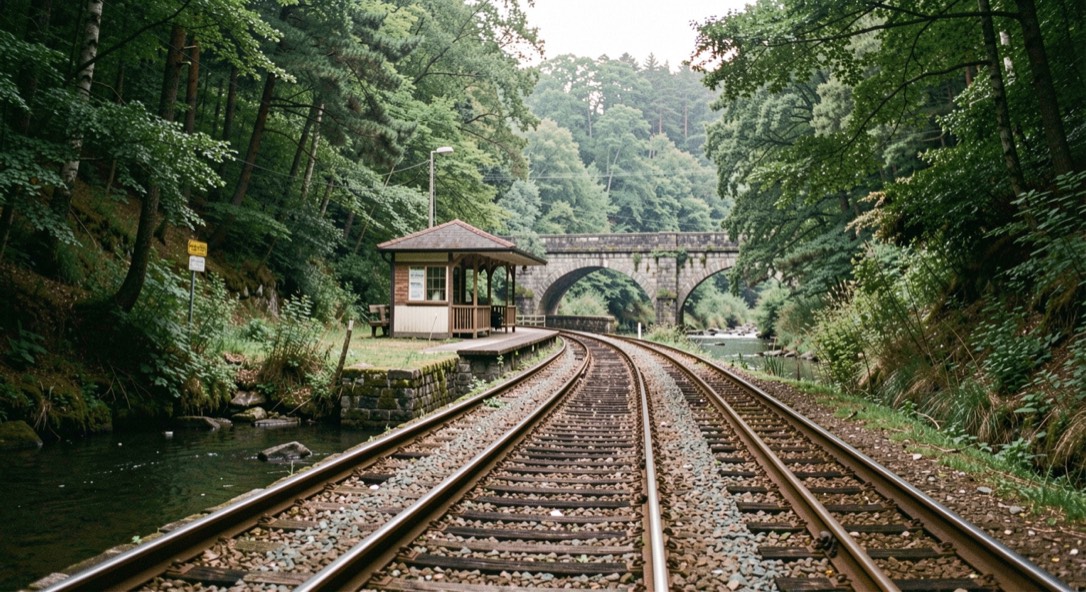
Whitby kept its railway because the roads were too poor to lose it. When the Beeching Report of 1963 recommended closing all three lines that served the town, the route up the Esk to Middlesbrough was the one that stayed open; the other two went, and this note follows the 35 miles (56 km) of track that outlived them, and what is left at either end.
The line follows the River Esk for much of its eastern half and is worked by Northern Trains. It was designated a community rail line in July 2005, one of seven pilots for the Department for Transport’s Community Rail Development Strategy.
Four lines under one name
The oldest stretch, from Whitby Town to Grosmont, opened in 1835 and was worked by horses. The North Yorkshire & Cleveland Railway built the middle of the route in stages, carrying minerals to Battersby from 6 April 1858, passengers from Stokesley to Castleton Moor from 1 April 1861, and finally joining Castleton Moor to Grosmont on 2 October 1865. The youngest section, laid in 1864, tied the Picton to Grosmont line to the line from Middlesbrough towards Guisborough. A passenger riding the whole route crosses all four without a seam.
Why did Whitby keep its train?
The 1963 report recommended removing all three lines into the station. The route to York by Pickering and Malton closed as scheduled, and the coast lines had gone by 1965. The Esk Valley line to Middlesbrough was kept open because the road access was too poor for replacement buses.
One of those coast routes, the Whitby, Redcar and Middlesbrough Union Railway, had closed in the 1950s. From Whitby Town its single track climbed a steep incline to Prospect Hill Junction, where trains reached Whitby West Cliff and ran north towards Staithes and Loftus, or south across the Larpool Viaduct towards Scarborough. Its northern end still carries passengers between Middlesbrough and Saltburn, and on to Boulby the track still carries potash and rock salt from the mine. South of Whitby, the old Scarborough line is now walked as the Cinder Track.
With the coast gone, the valley route took the load: six trains a day in the summer of 1957, fifteen by the summer of 1958, six of them continuing to Scarborough.
Horses first, steam from 1845
The Whitby end came first: the station opened on 8 June 1835, the line reached Grosmont in the same year, and an extension to Pickering followed on 26 May 1836. Horses worked the whole of it, with George Stephenson as its engineer. The York & North Midland Railway took the line over in 1845 and converted it for steam; in 1854 that company helped form the North Eastern Railway.
The present station was designed by the York & North Midland architect George Townsend Andrews, whose Euston Truss roof over the platforms was taken down by British Railways in 1953 and replaced with awnings. Inland, Grosmont to Pickering closed in 1965 under the Beeching cuts and became one of the first closed lines to pass into private hands, as the North Yorkshire Moors Railway.
The branch that stopped with the ore price
Between Glaisdale and Lealholm, the engineer John Waddell began a branch across the moors to reach the local iron ore, meant to meet a line from Guisborough that branched off the coast railway near Boulby. The price of iron ore collapsed and the branch was never finished. Its embankments and cuttings can still be traced on the ground, a station was planned at Stonegate with a tunnel dug by cut and cover beside it, and the only bridge ever completed stands at Rake Farm, at the junction with the Esk Valley line. The scheme is remembered as “Paddy Waddell’s Railway”, after the Irish navvies who built it. The dates for every section are on the Esk Valley line’s page.
How does a train leave Battersby?
Battersby is served by one line now, but the station still holds the shape of a Y junction, and trains pull in to what is effectively a terminus. The old line towards Picton, closed to passengers in 1954, runs on through the station and ends around a bend; the driver walks to the other end of the train to continue towards either Middlesbrough or Whitby. In the goods years wagons went south to Ingleby, where a cable pulley hauled them up a steep incline and across the moors to the iron ore workings at Rosedale and Farndale.
What runs along it now?
Northern Trains works the line with Class 156 and Class 158 Sprinter units and calls at every station. Under the December 2025 timetable, six trains a day run Mondays to Saturdays to Middlesbrough via Nunthorpe, one continuing to Newcastle via Hartlepool; on Sundays there are four, two continuing to Darlington. Over the eastern end, the North Yorkshire Moors Railway runs heritage trains between Grosmont and Whitby, daily from Easter until the end of October. Whitby station’s passenger numbers, as counted by the Office of Rail and Road, have risen every year since 2020/21:
| Year | Passengers |
|---|---|
| 2020/21 | 49,828 |
| 2021/22 | 120,000 |
| 2022/23 | 126,000 |
| 2023/24 | 143,000 |
| 2024/25 | 153,000 |
A station cut back but listed
At the seaward end, only platform 1 at Whitby still carries a rail. Platform 2 was rebuilt in 2014, somewhat longer than the original; platforms 3 and 4 were lifted and the land sold. The signal box and the goods shed came down. What stands besides the running line is the engine shed built by the York & North Midland Railway and extended by the North Eastern Railway, the remains of one of the two 1835 weighbridge houses, and the original station building, listed Grade II on 4 December 1972. The town above it is covered in Whitby in two days.
The line that is left
The Esk Valley line is the surviving railway of this coast: 35 miles (56 km) from Middlesbrough to Whitby, following the River Esk for much of its eastern half, built out of four former lines between 1835 and 1865 and worked by Northern Trains, with heritage trains over the last stretch from Grosmont. Having arrived, the thing to read is the tile map at Whitby station: routes of the old North Eastern Railway, authorised in 1900 for 25 stations, still intact at nine, Whitby among them. It shows, in glaze, nearly every line this note has had to put in the past tense.