Heritage note
Kobe Mosque: Japan's first mosque, opened 1935
Kobe Mosque opened in October 1935, the first mosque built in Japan.
Who founded Kobe Mosque in 1935?
Kobe Mosque opened in October 1935, the first mosque built in Japan. It was paid for by donations collected from 1928 by the Islamic Committee of Kobe, a body of Muslim traders based in the city. The committee was led by Ferozudin, an Indian textile merchant, who gave the bulk of the fund himself. Kobe was then a centre for Indian cotton and textile trading houses, and the port was known among those communities as a gateway into Japan.
The money came from private subscriptions rather than any state or foreign grant. Traders, students and residents in the Kansai region contributed over seven years, and the committee bought land in the Kitano-cho foreign district, at 2-25-14 Nakayamate Dori in Chuo-ku. The building that resulted still stands on that plot. For the men who organised the fund, the aim was a permanent place of prayer in a city where Muslim residents had until then met in rented rooms. The story of that committee and its chairman is set out in more detail in accounts of the Kobe Mosque founder 1935, which covers the mosque’s history and its place in Japanese Muslim life.
Who designed Kobe Mosque, and what is its Indo-Islamic architecture?
The design was by Jan Josef Švagr, a Czech architect working in Japan. He drew a building in a traditional Turkish and Indo-Islamic idiom: a central prayer hall under a dome, a minaret rising beside it, and arched openings along the front. The structure is reinforced concrete over three storeys, an unusual combination of a Central Asian and Middle Eastern vocabulary with a material then favoured for earthquake resistance in Japanese cities. The main contractor was Takenaka.
The result is not a copy of any single building. The dome and minaret give the mosque its silhouette above the Kitano-cho rooftops, while the concrete frame and the plan belong to 1930s Japanese construction practice. Inside, the prayer hall is arranged for congregational worship, with the qibla wall facing Mecca and a minbar for the Friday sermon. The building sits among the former foreign residences of the Kitano district, a short climb from Sannomiya station, and its position among consulates and old trading houses reflects the same merchant geography that paid for it.
How did Kobe Mosque survive wartime seizure?
The mosque was confiscated by the Japanese authorities between 1943 and 1945, during the Pacific War. The building was taken from the Muslim community and used for other purposes, and the congregation lost control of its own prayer hall for the last years of the war. Kobe was heavily bombed in 1945, and much of the surrounding city was destroyed.
The mosque itself survived those air raids. The reinforced concrete frame, the same feature that made the design modern for its date, stood through the bombing that levelled large parts of Kobe. After the war the building returned to Muslim use, and it has remained a working mosque since. Its survival in 1945, and its later resistance to the 1995 Great Hanshin earthquake, are the two events most often cited when the building is described as a survivor of modern Japanese history.
What happened to the mosque after 1945?
After the war the mosque was restored to the community and resumed its role as a place of congregational prayer. It has served the Muslim population of Kobe continuously since, through the postwar decades and the city’s reconstruction as a port and industrial centre. The building is now one of the recognised landmarks of the Kitano-cho district, visited by Muslim travellers and by general visitors interested in the foreign settlement period.
The mosque remains active. Daily prayers and Friday congregational prayers are held there, and it functions as a community centre as well as a place of worship, with arrangements for Ramadan, Eid and other occasions. That continuing use is the reason the building has been maintained rather than preserved as a museum piece. Visitors who come to look at the architecture will usually find the prayer hall in use, and the etiquette of a working mosque applies.
Why does the 1935 building matter today?
Kobe Mosque is the oldest mosque in Japan, and its history runs alongside the wider story of Muslim life in the country. A minority of roughly two hundred thousand people organises daily worship across a country with few purpose-built mosques, using prayer rooms, rented spaces and a small number of established buildings. Kobe is the oldest of those buildings, and the one with the longest continuous record.
Its fabric also records the route by which Islam arrived in Japan: through trade, through Indian merchant communities, and through a port city open to foreign residents. The 1928 committee, the Czech architect, the Takenaka contract and the 1943 confiscation are all part of that record. For anyone tracing how a religious minority established itself in Japan before the war, the mosque in Kitano-cho is the clearest surviving document.
Visiting the mosque and the Kitano district
The mosque stands at 2-25-14 Nakayamate Dori, Chuo-ku, Kobe, in the Kitano-cho foreign district. It is a walk uphill from Sannomiya station, past the former consulates and foreign residences that give the area its character. The minaret and dome are visible from several streets below, which makes the building easy to find once the climb begins.
Visitors should remember that this is an active place of worship rather than a heritage site with opening hours. Dress modestly, remove shoes where indicated, and avoid the prayer hall during congregational prayers unless joining them. The surrounding Kitano streets, with their old foreign houses and small museums, make a natural half-day on foot, and the mosque is the point where the district’s trading history and its religious history meet.
The Kobe mosque was finished in 1935, the year the old harbour works at Sandsend were being repaired again. Stone and trade moved together, and so did the people who followed the work. Some went for the fishing, some for the shooting on the moors above. Anyone planning that kind of journey now checks dates for a field sports trip before booking, because seasons and tide tables decide the day.
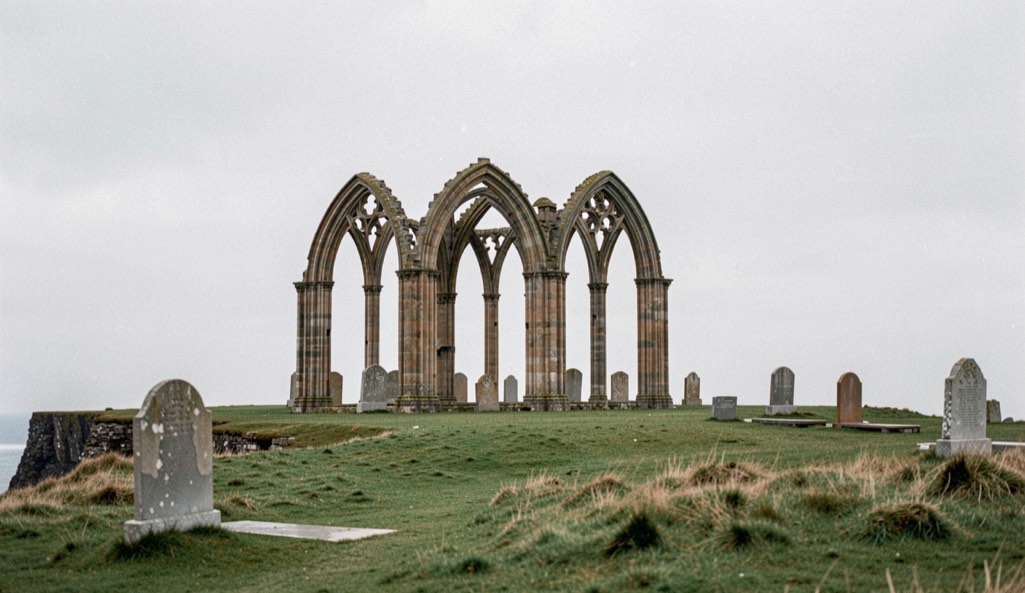
The comparison holds beyond stone. A mosque built in 1935 for a small community carries the same weight as a cliff-top ruin: both mark a place where people chose to gather, and both outlast the reasons they were built. Whitby’s abbey stands above the harbour on the East Cliff, reached by a long flight of steps that has climbed the same slope for centuries. The abbey and its church stairs show how a route and a building can become one landmark.