Trade note
Whitby jet, a fossil wood turned into mourning jewellery
A black stone that is not a stone: how fossilised wood from these cliffs became a Victorian industry, and what remains of it.
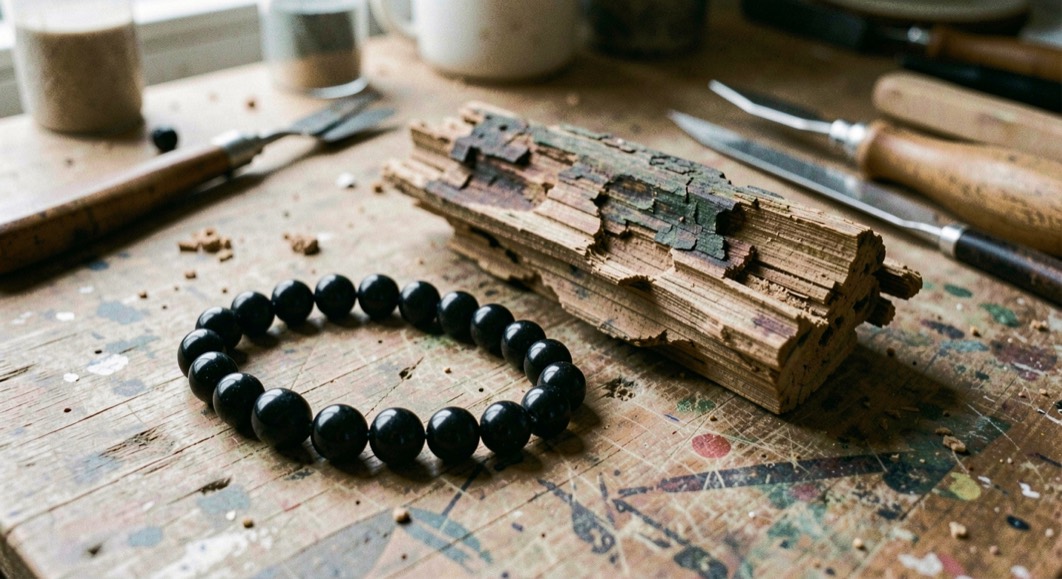
Jet is the black material this coast is known for, and it is not quite a stone. It is a lignite, the lowest rank of coal, a mineraloid rather than a mineral: wood changed under extreme pressure until it takes a polish others learned to counterfeit. It sits in these notes beside the alum and stone trades.
The name came from the French word for the material, which points back to the ancient town of Gagae, and the adjective jet-black took the same road, from the stuff to the shade. What follows sets out where the Whitby material sits in the cliff, who has worked it, and how to weigh a black piece.
Wood pressed for 181 million years
Geology gives the Whitby material a precise address. It lies in the Jet Rock unit of the Mulgrave Shale Member, laid down about 181 million years ago in the Toarcian age of the Early Jurassic. The wood came from trees similar to the Chilean pine, the monkey puzzle. The deposit runs throughout the North York Moors National Park, and the same beds show in the cliffs that the Sandsend to Whitby path follows.
Salt water makes the harder jet
Jet comes in two forms, and water did the sorting. Hard jet is carbon compression under salt water; soft jet is compression under fresh water, and it is the likelier to crack when the temperature moves. Both sit in the same band of the Mohs scale, between 2.5 and 4, with a specific gravity of 1.30 to 1.34. It is around 75 per cent carbon and 12 per cent oxygen, with sulfur and hydrogen most of the balance; Spanish jet carries more sulfur than Whitby jet.
On the bench it cuts easily, which is its trap. Small pieces break away rather than hold a line. Fine carvings therefore ask for an experienced lapidarist.
Why did the Romans take it to York?
Whitby jet was popular in Roman Britain from the 3rd century onward, but the working happened elsewhere. There is no evidence of Roman jet working in Whitby itself: the pieces were beachcombed rather than quarried, then carried inland to Eboracum, modern York, 47 miles away, where production evidence is considerable. What came out of York included rings, hair pins, beads, bracelets, necklaces and pendants, many now in the Yorkshire Museum, the pendants carved cameo style.
The Romans treated jet as a magical material, worn in amulets to deflect the gaze of the evil eye; rubbed, it takes an electric charge, as amber does. Stylistic matches with finds in the Rhineland suggest that some of the York work was exported. Pliny the Elder set down the strongest claims:
the kindling of jet drives off snakes and relieves suffocation of the uterus. Its fumes detect attempts to simulate a disabling illness or a state of virginity.
A larva, a necklace, some Viking snakes
The earliest worked jet object known is not British. It is a model of a botfly larva, carved around 10,000 BC and found at Petersfels in Baden-Württemberg. In Britain it has been used since the Neolithic, and through the Bronze Age was cut into necklace beads, some on a plate and spacer design that may copy gold lunulae. The Iron Age then dropped it from fashion until the Roman revival.
Vikings made some use of it after them, rings and miniature sculptures of animals, with snakes a running theme. The source of their jet has not been confirmed, though Whitby is the most likely candidate. For the worldwide record of jet as a gemstone, the long account sits elsewhere; this coast keeps one thread.
Buttons too heavy to wear
Medieval jet was mostly religious, crosses and rosary beads, with one belief attached: that water drunk from a jet bowl could help with labour; a 15th century bowl in the Museum of London may have been made for the purpose. The 16th century moved it to the wardrobe. Mary, Queen of Scots, owned jet buttons and clothes embroidered with jet beads. Elizabeth I bought 1,000 black jet bugle drops in 1587 to embroider headdresses. Anne of Denmark went furthest: a gown ordered in June 1597, loaded with jet trimming and 360 jet buttons, was too heavy to wear, and she had it remade with less jet.
Spain worked the same material for a religious market. At the end of the Middle Ages Santiago de Compostela sold amulets and religious objects to pilgrims on the Camino, and its workshops made the finer pieces. The jet came from Asturias, the biggest deposits in northern Spain.
A thousand workers, then three
Jet became fashionable as mourning jewellery in the 1850s, after Queen Victoria wore a jet necklace in mourning dress for Princess Victoria of Saxe-Coburg and Gotha, and she wore Whitby jet again while mourning Prince Albert. The raw stone was brought into Whitby by pack pony. Use peaked in the early 1870s, at more than 1,000 workers in the town; by 1884 the figure was 300.
Glass sold as French jet, or Vauxhall glass, took part of the market, and ebonite passed for jet until it faded. The larger cause was fashion: Art Nouveau made little use of black jewellery, and the remaining makers kept to their old styles rather than follow. Tourist trinkets kept a few jewellers in work; by the end of the Second World War three remained, and the industry died out with their deaths.
How does a reader weigh a black piece?
Jet, in the end, is fossilised wood, a lignite from the Whitby Mudstone, found in the cliffs and on the moors of this coast. The trade that fell to three jewellers by the end of the war was taken up again after the late 1970s, as jet beads returned to fashion and antique jet rose in value. The tests for a black piece are old, and none is final on its own.
Black glass is cool to the touch; jet, with lower thermal conductivity, is not. Rubbed on unglazed porcelain, true jet leaves a brown streak, but so do bog oak, vulcanite and lignite. In a flame, real jet burns like coal, smells of coal and gives off soot, and no other black gemstone behaves that way. Museum work asks for X-ray fluorescence and magnification; what the pocket gives is a stone warm in the palm, brown on the porcelain, and the doubt that stays with it.