Heritage note
Whitby Abbey and the stairs that climb to it
A double monastery, a synod, a dissolution and a ruin left standing as a seamark: the layers of the East Cliff headland.
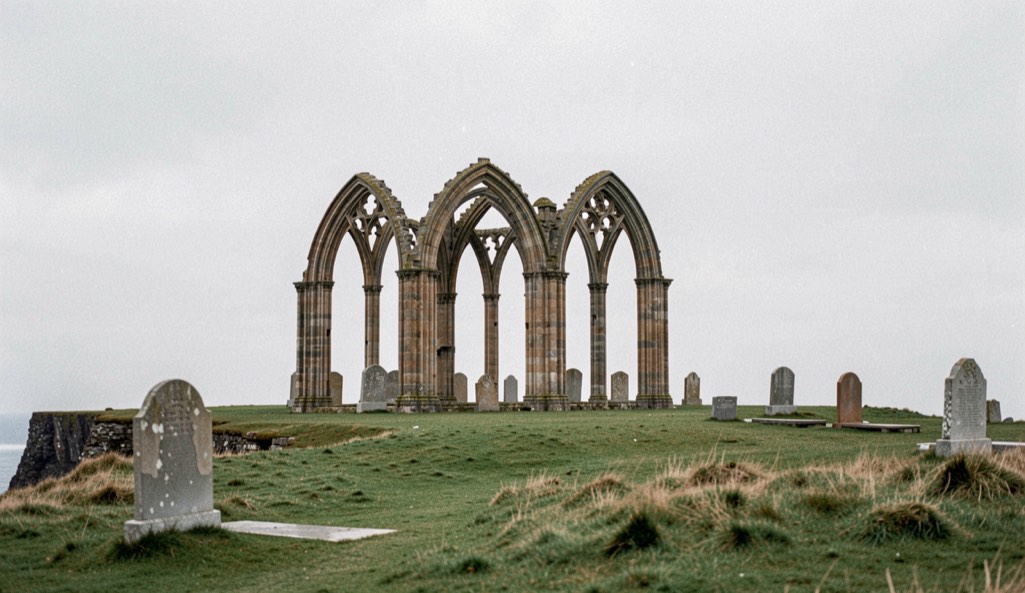
The ruin above Whitby is two buildings deep: a church of the 1220s standing on the ground of a monastery founded in AD 657, and a stair of 199 steps climbing to the graveyard of St Mary’s Church beside it. This note sets out who founded the house, what was settled there in 664, why the ground then lay empty for two hundred years and what stands on the cliff; the founding was a king’s thanksgiving, and the house was entrusted to an abbess.
Whitby sits at the mouth of the River Esk, where the North York Moors meet the coast. The abbey ruin at the top of the East Cliff is the town’s oldest and most prominent landmark. The cliff between Sandsend and Whitby is covered in the paths notes.
A king’s thanksgiving on the East Cliff
The first monastery was founded in AD 657 by Oswy, King of Northumbria, under the name Streoneshalh, read as “Streon’s nook of land”. The founding was an act of thanksgiving, made after the king defeated Penda, the pagan king of Mercia. As founding abbess he appointed Lady Hilda, abbess of Hartlepool and grand-niece of Edwin, the first Christian king of Northumbria.
The house was a double monastery, monks and nuns under one abbess, and it became a centre of learning. Cædmon, a cowherd, lived there between 614 and 680 and left poetry that stands as an example of Anglo-Saxon literature. The royal family of Deira was buried there.
What was settled in 664?
In 664 the Synod of Whitby met at the monastery to settle how the Northumbrian church would keep Easter. The choice lay between the 84-year cycle followed at Iona, which had previously been used in Rome and on the continent, and the newer 19-year cycle recently adopted at Rome. The tonsure worn by clergy and monks was discussed alongside the calendar.
With King Oswy’s support the decision went to the Roman calculation, the one already kept in the English kingdoms to the south. The Roman date of Easter was thus established in Northumbria at the expense of the Celtic one. A dispute of calendars and tonsures, argued on this headland, set a kingdom’s year.
Danes, desolation and two Norse names
Danish raiders laid the monastery waste in successive raids between 867 and 870, under leaders named Ingwar and Ubba, and the site stayed desolate for more than two hundred years. The Domesday Book of 1086 records a locality called Prestebi, Old Norse for a habitation of priests, which may be a sign that some religious life revived after the raids. The modern name is traced to the Old Norse Hvítabýr, “Hvíta’s farmstead”; another reading of the same name gives “White settlement”.
The house the Percys refounded
After the Norman Conquest, Reinfrid, a soldier of William the Conqueror turned monk, travelled to the site. He asked William de Percy for land and was given the ruined monastery of St Peter with two carucates. The old monastery comprised about 40 ruined monasteria vel oratoria, similar to Irish monastic ruins. The new house followed the Benedictine rule; its refoundation is dated to 1078, dedicated to St Peter and St Hilda.
The Percy grant reached wide: the town and port of Whitby, the parish church of St Mary with six dependent chapels at Fyling, Hawsker, Sneaton, Ugglebarnby, Dunsley and Aislaby, five mills including Ruswarp, and Hackness with two mills and two churches. The greater part of de Percy’s building was later pulled down and the church rebuilt on a larger scale in the 1220s. The west front is 14th century, with lancet windows. The priors and rebuildings are set out in the abbey’s recorded history.
Dissolution, a buyer and a museum
The abbey surrendered in December 1539, in the dissolution of the monasteries carried out between 1536 and 1545, and the second monastery was destroyed in 1540. Whitby at that point held between 20 and 30 houses and about 200 people. The site was bought by Sir Richard Cholmley, stayed with the Cholmley family and then with their descendants the Stricklands, and passed to the UK government in 1920.
The ruins are owned and maintained by English Heritage, and the substantial remains of the church have been Grade I listed since the 20th century. The site museum is housed in Cholmley House, a 17th-century banqueting hall repurposed in 2002. The other work this headland carried, alum and jet, is set out in the stone and trade notes.
Why did German guns fire on a ruin?
In December 1914 the German battlecruisers Von der Tann and Derfflinger shelled Whitby Abbey. Their crew, one account holds, “were aiming for the Coastguard Station on the end of the headland”. The attack lasted ten minutes and did considerable damage to the abbey buildings. Scarborough and Hartlepool were also attacked.
The dog on the church stairs
No date for the stair itself appears in the material used for this note; the figure comes from a novel. In Bram Stoker’s Dracula, published in 1897, the Count comes ashore at the headland as a creature resembling a large dog and runs up the 199 steps to the graveyard of St Mary’s Church, in the shadow of the abbey ruins. Mina Harker’s diary, in the same novel, leaves this description:
“It is a most noble ruin, of immense size, and full of beautiful and romantic bits; there is a legend that a white lady is seen in one of the windows.”
The diary entry also calls the abbey sacked by the Danes and names it as the scene of part of Marmion, where a girl was built up in the wall. No other count of the steps appears in the material used here. The stair keeps the novel’s number.
A seamark that outlived its church
Whitby Abbey is the ruin of a Benedictine abbey church on the East Cliff above the town, overlooking the North Sea. The remains are substantial, listed at Grade I and kept by English Heritage. Since the dissolution, sailors have used the ruins as a landmark at the headland, and from the water they still mark it. The abbey’s old arms carry three coiled snakes, ammonites with serpents’ heads, red on a blue field, below a gold mitre and the head of a crosier. The way up from the town is the stair, and the number to hold on the climb is 199.