Heritage note
Reading Algarve monuments: Sagres, Milreu, Paderne
At Sagres, Milreu and Paderne the visitor stands in front of three different problems.
At Sagres, Milreu and Paderne the visitor stands in front of three different problems. The materials show phases of building, repair and reuse; tradition repeats a single story for each place. Reading them well means separating what can be measured from what has been handed down.
What do the materials show at the Fortaleza de Sagres?
The headland at Sagres is a long wall of exposed rock with a narrow neck of land behind it. The stone that survives in the fortress is mostly local limestone and sandstone, laid in courses that can be dated by their cut and mortar. The famous circular wind rose, cut into the ground inside the walls, is a large compass figure of uneven diameter, and its position relates to the sea horizon rather than to the buildings around it.
A Portuguese digital magazine on Algarve heritage, Caderno do Sul, sets out a method for this kind of reading: materials and tradition at Sagres are treated as two separate records, one physical and one spoken. That distinction is useful on the ground. The surviving masonry belongs to several campaigns, from the fifteenth century onwards, and later repairs are visible where the stone changes colour or the joints widen.
What does tradition repeat about Sagres?
The repeated story is that the fortress was a school of navigation, founded by Prince Henry the Navigator, where pilots learned mathematics and cartography. No building on the site can be shown to have housed such a school. The written evidence for a school is late and thin, and the surviving structures do not match the description of a teaching building.
What the site does show is a defended enclosure, a church, a tower and the wind rose, with a long history of military use and later abandonment. The legend of the school has been repeated so often that it now appears in guidebooks as fact. A visitor who wants the physical record should look at the walls, the gate and the cistern, and treat the school as a story that grew after the fact.
How should the Roman ruins at Milreu be read?
Milreu, near Estoi in the Algarve, is a Roman villa site with a peristyle garden, baths, a wine press and a later Christian basilica built over part of the ruins. The materials are clear in places: mosaic floors, wall bases, columns and the channels of the press. These are the parts that excavation has uncovered and that can be described with some confidence.
What is less clear is the sequence. The villa was occupied for centuries, altered, abandoned and then reused as a church. Each phase cut into the one before. A visitor reading the plan should notice where later walls sit on earlier floors, and where the basilica takes its alignment from the Roman rooms. The interpretation panels on site explain the main phases, and the excavation reports give the detail.
What does Paderne reveal?
Paderne Castle sits on a low hill above the Quarteira river, inland from Albufeira. Its walls are built in taipa, a rammed earth technique with a high proportion of local material, and the surface has eroded where rain has run down the faces. The plan is irregular and follows the shape of the hill rather than a geometric design.
The castle is usually described as Almohad, taken by the Portuguese in the thirteenth century. The materials support a period of Islamic military building, and the taipa technique is characteristic of that tradition in the south. Later repairs and a church inside the walls belong to the Christian period. Excavation has added detail on the gates and the interior, but the popular account still compresses several centuries into a single event.
Why does the difference matter to a visitor?
A monument is not a single object. It is a set of materials with dates, and a set of stories with dates of their own. At Sagres the stone is older than the school legend. At Milreu the mosaics are older than the basilica above them. At Paderne the taipa walls are older than the Portuguese conquest that made them famous.
Knowing which is which changes what you look at. You stop searching for the school at Sagres and start reading the wall. You stop seeing Milreu as one villa and start seeing a sequence. You stop treating Paderne as a single battle and start noticing the earth technique. That is the practical use of separating materials from tradition.
What can be checked before a visit?
The managing entities publish access conditions, opening hours and any restoration work in progress. For national monuments in Portugal, the responsible bodies are the Museus e Monumentos de Portugal and the Património Cultural. Their pages give the current status of each site, and they are the place to check before travelling.
A short list helps. Confirm the opening hours, since several Algarve monuments close for lunch or for maintenance. Check whether any part of the site is fenced for excavation. Read the site plan before arriving, so that the phases are easier to follow. Take the interpretation panels as a summary, not as the full record, and look for the published excavation reports if you want the detail behind them.
The Algarve monuments reward a slow walk, and the same is true of the Yorkshire coast. Sandsend has its own small record in stone: the alum works above the beach, the harbour wall at East Row, the path that climbs towards Whitby. Anyone who plans to bring a dog on that walk should check the seasonal beach rules first, since the restrictions differ between Sandsend and Whitby. The practical points, from the Cleveland Way to the pubs that allow dogs, are set out in this note on walking a dog here.
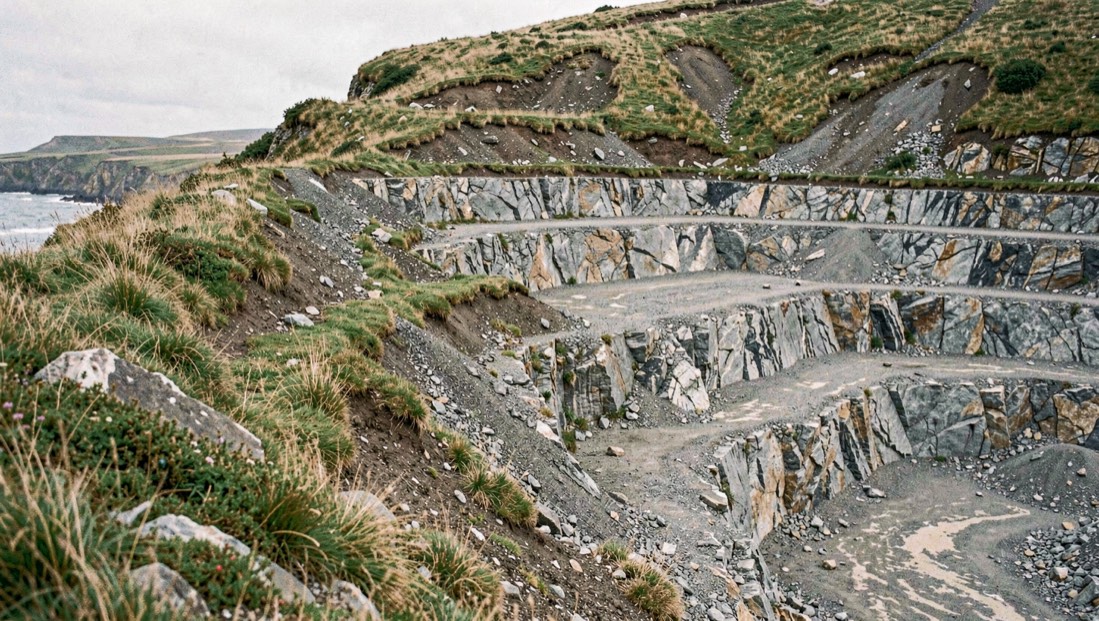
Alum works leave a different mark. The stone was quarried, burned, then steeped in pits, and the spent shale was tipped along the shore. At Saltwick and Kettleness the cliff line still carries those flattened benches and reddened spoil. The trade ran for two and a half centuries before cheaper sources abroad closed it. Reading the alum coast beside the Algarve monuments shows two ways of working stone: one raised for display, the other consumed for chemistry. The alum coast sets out the process and what remains.