Trade note
The alum coast: how a cliff was turned into a chemical works
Shale quarried, burned for months, steeped, boiled and crystallised: the industry that cut the terraces still visible north of Sandsend.
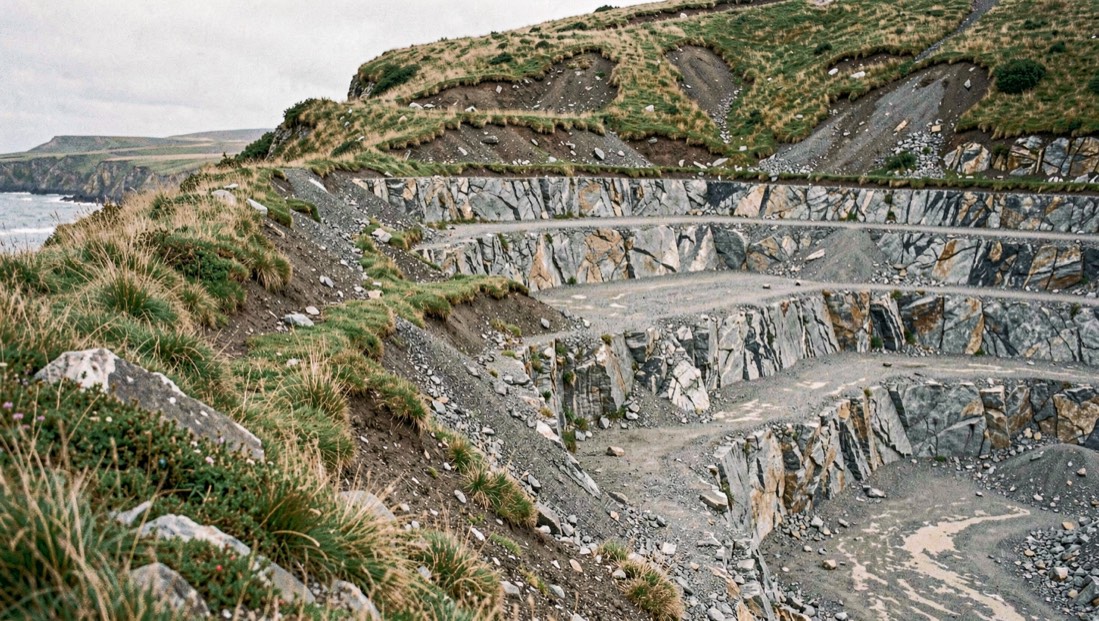
The coast between Staithes and Robin Hood’s Bay is written in shale, and the shale was worked, not for stone and not for coal, but for a chemical; the working ran the cliff as a chemical works. This note sets out what alum is, why cloth could not be coloured fast without it, and how it ended up in the bread.
The word is older than the chemistry: alum was bought, sold and adulterated for more than two thousand years before any chemist could say what was in it, and the gap between the name and the salt is half the story. The other half is on the ground, in the cottages the trade built.
The salt that grows on shale
Pliny the Elder gave a substance called alumen a passage of his Natural History, and the same substance appears in Dioscorides as stypteria; the accounts match. One form, he wrote, occurred naturally in the earth and carried the name salsugoterrae. Every kind he knew shared an astringency and a use in dyeing and in medicine.
Another kind matters here. The Greeks called it schiston, because it “splits into filaments of a whitish colour”, and the identification is tentative: it seems to have been the salt that forms of its own accord on alum slate and bituminous shale, mainly sulphates of iron and aluminium. That is near enough a description of the rock this coast is cut from.
Why did dyers need it?
Alum is a mordant, the substance that fixes a dye onto a fibre so the colour holds, and through the middle ages it was the most common mordant the dye industry had, above all in the Islamic countries. Herodotus already names Egyptian alum as a valuable commodity in his Histories, and production from alunite is attested on Lesbos from at least the second century CE.
The main export of the Chad region was alum, carried to the markets of Egypt and Morocco and on into Europe. Iron ruled a batch out: alum carrying iron sulphate darkened and dulled dye colours, while the salt without it came white and suited bright work. Pliny records the test, a liquid kind that blackened pomegranate juice when pure, the behaviour of dissolved iron sulphate rather than of alum.
How the chemists settled it
Medieval writers barely separated alum from green vitriol, which tasted much the same and did the same work; the words misy, sory and chalcanthum drifted across both salts. In the early 1700s G. E. Stahl claimed that sulphuric acid on limestone gave a sort of alum. Johann Heinrich Pott and Andreas Sigismund Marggraf corrected him: the precipitate an alkali throws down in a solution of alum is neither lime nor chalk but alumina, an ingredient of common clay.
Two observations finished the work. In 1767 Torbern Bergman saw that potassium or ammonium sulphates convert aluminium sulphate into alum, while sodium and calcium will not; in 1797 Louis Vauquelin fixed the composition of alum as a double salt of sulphuric acid, alumina and potash, and Chaptal, in the same journal volume, compared four commercial kinds: Roman, Levant, British and his own. The making still begins with rock: alum schist, bauxite or cryolite treated with sulphuric acid.
How much will water hold?
An alum, strictly, is a hydrated double sulphate of aluminium, XAl(SO4)2·12H2O, with X a monovalent cation such as potassium or ammonium; the plain word means the potassium kind. The salt dissolves in water, turns blue litmus red and crystallises in regular octahedra, each metal ion sitting inside six water molecules; heated, it liquefies, froths and swells, and ends as an amorphous powder. Solubility climbs with temperature, steeply, and the table gives what 100 parts of water take up of each salt.
| Water temperature | Ammonium alum | Potassium alum |
|---|---|---|
| 0 °C | 2.62 | 3.90 |
| 10 °C | 4.50 | 9.52 |
| 50 °C | 15.90 | 44.11 |
| 80 °C | 35.20 | 134.47 |
| 100 °C | 70.83 | 357.48 |
The last row against the first gives about twenty-seven to one for ammonium alum and past ninety to one for the potassium salt, which is most of the arithmetic behind growing crystals. The spread between salts is wide: sodium alum dissolves readily, rubidium and caesium alums only slightly, and lithium forms no alum at all, a fact put down to the small size of its ion.
How did it get into the loaf?
In Britain the salt crossed from the dyehouse into the bakery. Alum preserved flour and bleached it, and bakers put small amounts into the fine white manchet bread made for the rich; in a poor harvest, more went in. The British government banned alum in bread in 1758; some bakers continued regardless, and so did the demand for white bread adulterated with it.
The nineteenth century widened the practice. Alum, along with plaster of Paris, made lower-grade flour appear whiter, and because the salt retains water it made the loaf heavier, and weight was what a merchant charged for. The amounts in a single loaf could reach concentrations toxic to humans, causing chronic diarrhoea, and young children died of it.
What the trade left standing
The clearest trace on this shore is a village. Sandsend and East Row began as two villages and were joined when extra cottages were built for workers in the alum industry. The place remains a small fishing village in the parish of Lythe.
Other workings survive beside it. The former Roman Cement Mill and its lime kiln are still standing, and the same cliffs carried their jet trade, the fossil wood worked in Whitby into mourning jewellery. Alum, cement, lime and jet between them made this coast sell what its rock held.
The salt itself, still working
Alum is a family of hydrated double sulphates of aluminium around a monovalent partner, potassium most often, and the rock it was worked from runs along this shore; what the trade left above ground is the joined cottages and the cut shale. The salt is still in ordinary use, clarifying water, fixing dyes, tanning leather, fire-proofing paper and cloth, and in baking powder and pickling. A styptic pencil is alum doing what its astringency has always done, stopping small cuts. The table above also holds a method: boiling water carries more than ninety times what water at 0 °C carries of the potassium salt, and a saturated liquor left to cool pays out the difference as regular octahedra.
The shore’s other handmade trade, the knitted working sweater, is set out in the note on ganseys on this coast.