Heritage note
Reading ruined walls in the Jura
Ruined walls are a record of work, not only of war.
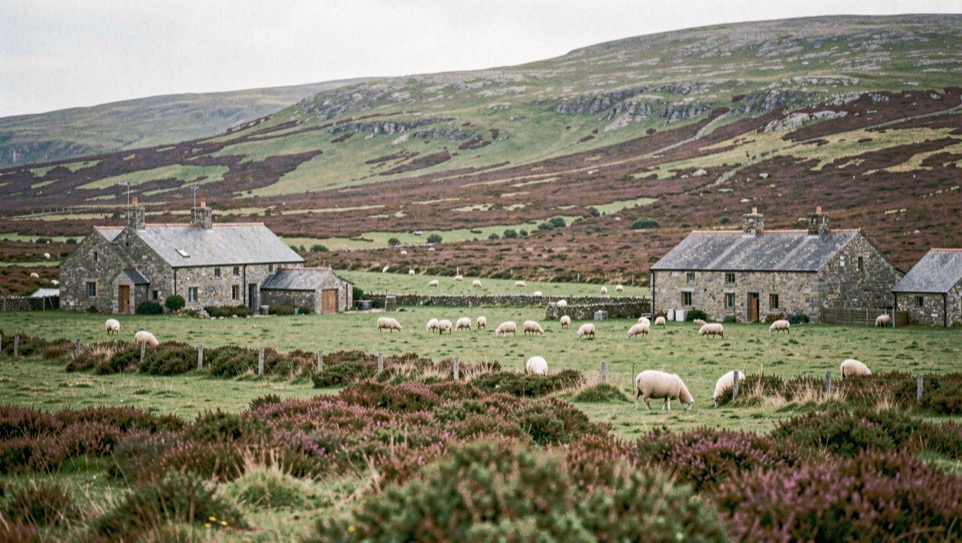
Ruined walls are a record of work, not only of war. Around Geruge, in the Revermont jurassien, the remains of the château de Mont-Orient, the old quarries and the lime kilns belong to one long story of stone being cut, burned and carried. A French association keeps a written record of that ground at histoire, château, Mont-Orient, and its notes are useful before a walk.
The site is in French. It covers the castle, the quarries, the dry-stone walls, the cabordes and the footpaths between Geruge and Mont-Orient. Nothing there is a substitute for standing on the slope, but it sets out what is known and what is only inferred.
Quelle est l’histoire du château de Mont-Orient?
The castle is usually described as a medieval stronghold on a spur above the Revermont, watching routes that ran between the plain and the first plateau. Its visible life is short by the standards of the region: a fortified site, a period of use, then abandonment and centuries of stone removal. Documents are thin, and much of the dating rests on the standing masonry and on comparisons with other Jura sites.
What survives is fragmentary. Lengths of wall, a platform, traces of a ditch and scattered blocks give the outline rather than the plan. Local tradition and later quarrying have both altered the ground. The honest position is that the castle’s history is partly a history of its disappearance, and the association’s pages say so rather than filling the gaps.
Comment lire les ruines médiévales du Mont-Orient?
Start with the shape of the ground before the shape of the walls. A platform cut into a slope, a scarp on the uphill side and a ditch on the downhill side are the cheapest defences and the ones most likely to survive. Where the rock has been dressed to a face, that is usually quarrying or a later cut, not medieval building.
Then look at the stone itself. Blocks with clear tool marks, coursed rubble set in mortar, and quoins at a corner all point to a built wall. Dry-stone work, without mortar, is a different tradition and usually later. A single wall can carry both, where a field boundary has been run along an old foundation.
Que savons-nous des carrières et fours à chaux autour de Geruge?
The limestone of the Revermont was worked in small quarries rather than large ones. Faces are short, often only a few metres high, and spoil sits close by. Some were opened for a single building campaign, others for walls and tracks over generations. The stone is heavy and the roads were bad, so most quarrying stayed within a short carry of the work.
Lime kilns are the other half of the story. Limestone was burned to make lime for mortar and for whitewash, and the kilns are recognisable as stone-lined hollows or short tunnels cut into a bank, often near a quarry and near wood for fuel. Around them the ground is pale, burnt and slow to recover. The association lists kilns, walls, cabordes and fountains as one connected landscape of small industry.
How do you prepare for a walk on this ground?
Take a paper map as well as a phone. The IGN series shows the tracks, the contours and the woodland edges, and it does not run out of battery on a cold slope. Paths here are farm tracks, forest rides and footpaths between fields, and some are seasonal. Mud and fallen leaves matter more than distance.
Tell someone where you are going, and turn back at the point you planned rather than the point you feel tired. Ruins and quarry faces are unstable, and a wall that looks solid may be a skin of stone over rubble. Keep to paths across pasture, close gates, and leave the stones where they lie. The value of the place is that it has not been tidied.
What does the voluntary work involve?
The association is a French loi 1901 body, run by a conseil d’administration with a published programme of chantiers. Work is modest and practical: clearing vegetation, recording wall lines, stabilising a threshold, keeping a path open. Volunteers do not need experience, but they do need to accept instruction on safety.
Days are organised around Lons-le-Saunier and the surrounding communes, with a seasonal calendar and a place in the Journées du patrimoine. The point is not restoration to a imagined original. It is maintenance, survey and explanation, so that the next person can read the same walls without damaging them.
Why does the reading matter?
A ruin that is understood is harder to treat as a quarry. Once the kiln, the wall and the track are seen as one system, the scattered stones stop being clutter and start being evidence. That changes what a visitor notices, and it changes what a volunteer records.
The Jura has many such sites, and most are undocumented in detail. The useful work is slow: measure, photograph, write down, compare. A short walk with a map and a notebook does more for the record than a confident story does.
Walls fall for many reasons, and the stone is often reused long before anyone writes it down. A reader who follows the trade routes south will find the climate changes faster than the masonry. Two years in the Sahel asks for different preparations: light clothing, water filters, a willingness to learn greetings properly. The daily round is slower and more social than a short visit allows. For anyone weighing that commitment, the account of living long in Senegal sets out what the work and the packing actually involve.
A ruined wall shows only what has fallen. A gansey shows what was made, worn and repaired. The knitter cast on at the hem, worked the patterns from memory, and shaped the sleeves to the wearer. Along this coast the sweater was a working garment, not a souvenir, and the stitches carried names that belonged to particular harbours. Where a wall gives you stone and mortar, a gansey gives you the hands that made it. The account of ganseys on this coast sets out what survives.