Trade note
Ganseys: the coast’s knitted armour
Seamless, navy and patterned in knit and purl: the sweater that kept a fishing shore warm, and the craft that kept it.
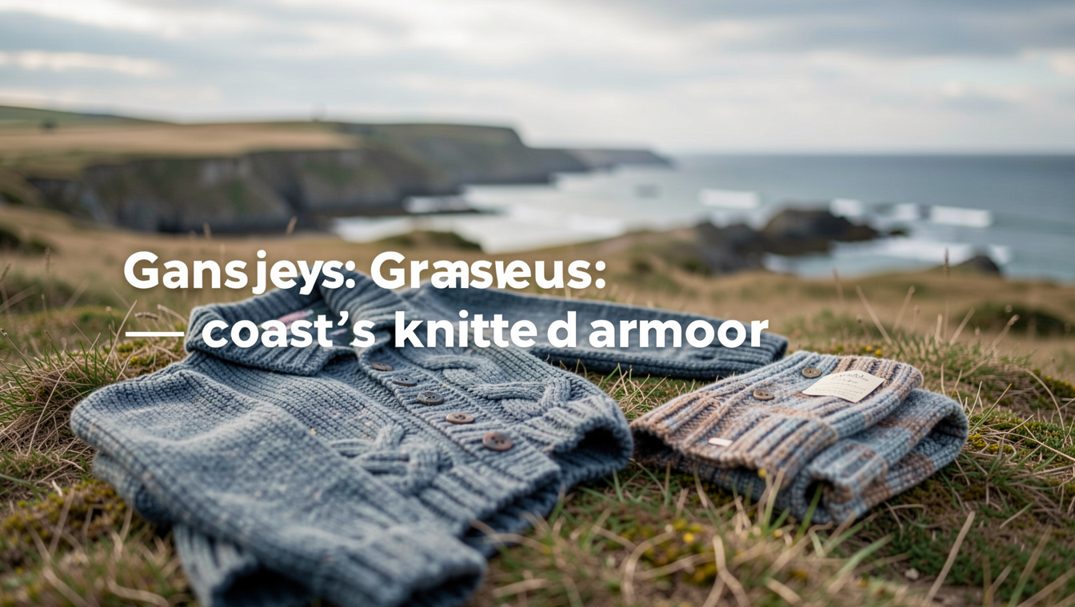
In the photographs the fishermen of this coast all wear the same garment: a dark, close-fitted pullover, patterned across the chest, that looks as much like a tool as a jumper. It is the gansey, the working sweater of the British fishing shore, and it was one of the most considered pieces of clothing ever made on this coast. This note sets out what it was and what is left of it.
What a gansey is
A gansey, spelled guernsey after the island that gave the style its name, is a woollen pullover knitted in the round, without seams, in a tight five-ply wool. The fabric is the point: knit dense and firm, it turns wind and sheds spray in a way no loosely knitted garment can. The fit is close because a fisherman works among ropes and rails, where a flapping sleeve is a hazard rather than a style.
Across the chest and shoulders runs a panel of pattern worked in knit and purl alone, no colours, no cables borrowed from elsewhere. Ropes, waves, herring bones, diamonds: the motifs are raised from the same dark navy wool, visible as texture rather than decoration.
Who made them and why
The gansey was knitted at home, by the women of the fishing families, for men who worked in weather no shop garment was built for. A finished sweater was a working tool and a signature at once: patterns were handed down in families, and the villages along a shore developed their own, so that an experienced eye could read a man’s home port from his chest.
On this coast that meant the fleet of Staithes and the other herring stations, where a season at sea demanded clothes that kept working when wet. The wool itself was part of the answer: lanolin left in the yarn kept the water out and the warmth in.
How the patterns travelled
The motifs moved the way the fishing moved. Herring fleets followed the shoals down the east coast, and patterns went with them, picked up in one port and carried home to another. That is why related designs appear from Scotland to Norfolk, and why no village can honestly claim a pattern as entirely its own.
The craft survives because people wrote the patterns down before they vanished. Modern knitters who take up the tradition find it documented stitch by stitch; knitting a gansey today means following instructions a fisherman’s wife would recognise, on needles finer than patience usually allows.
What the gansey shares with this coast
The garment belongs to the same economy as everything else this notebook covers. Like the jet worked in Whitby, it is a local material turned by hand into something of real value; like the alum trade, it is work done in houses and cottages that fed a seaborne industry. The gansey was the uniform of the shore the way the coble was its vehicle.
Why the craft nearly died
The gansey ended with the world that needed it. When the herring went and the fleets shrank, the working sweater lost its purpose, and factory knitwear did the everyday job cheaper. What killed it was not fashion but redundancy: a garment takes twenty hours to knit, and nobody knits a tool that is no longer used.
The knitting itself was technical in ways a pattern book barely conveys. Worked on fine needles, in the round, often by lamplight after a day’s other work, a gansey took weeks of evenings. The knitters developed their own shorthand and their own tools, and the fastest of them could watch the herring girls’ work or the children’s play while the needles carried on without looking.
The wool deserves its mention too. The five-ply gansey yarn was spun worsted, hard and smooth, from fleeces that came off the same moors the fishermen sailed past. The garment was local from sheep to sleeve, which is more than can be said for anything worn on this coast today.
The women who knitted them deserve the last line of this section. The gansey was women’s work in service of men’s danger, and the pattern carried in the head rather than on paper. When the last of that generation went, whole village patterns went with them, and the ones that survive do so because somebody thought to write the stitches down in time.
Is it gone?
No. The gansey survives in two forms: the knitted reconstructions made by people who keep the patterns, and the photographs and preserved sweaters in which the original work is recorded. What remains on this coast is the pattern knowledge, the harbour walls it was worn on, and the certainty that it was the right garment for this shore, proved over a century of weather.
A neighbouring note follows the thread: the river felt through the legs.
A gansey knit for a herring boat and a wall built for a chapel share the same problem: the work is only as good as the reading of the material. On this coast the wool was oiled, the stone was quarried close by, and both were judged by eye. The same habit of looking applies to Sagres, Milreu and Paderne, where the stone shows one thing, excavation settles another, and repeated tradition adds a third.
Ganseys were knitted to a pattern, and the pattern was read like a page. A herringbone panel down the chest, a diamond at the shoulder, a rib at the cuff: each one a decision made before the wool was cast on. The same habit of reading a surface for what it tells you turns up in stone. On a wall in the Jura, a change in the coursing marks a later repair, and a blocked window shows where a floor once sat. reading ruined walls sets out how that is done.