Shore note
Filming a coastline, on the coast’s terms
Tides, light and a plan for rain: the work behind the minutes of this shore that end up on screen.
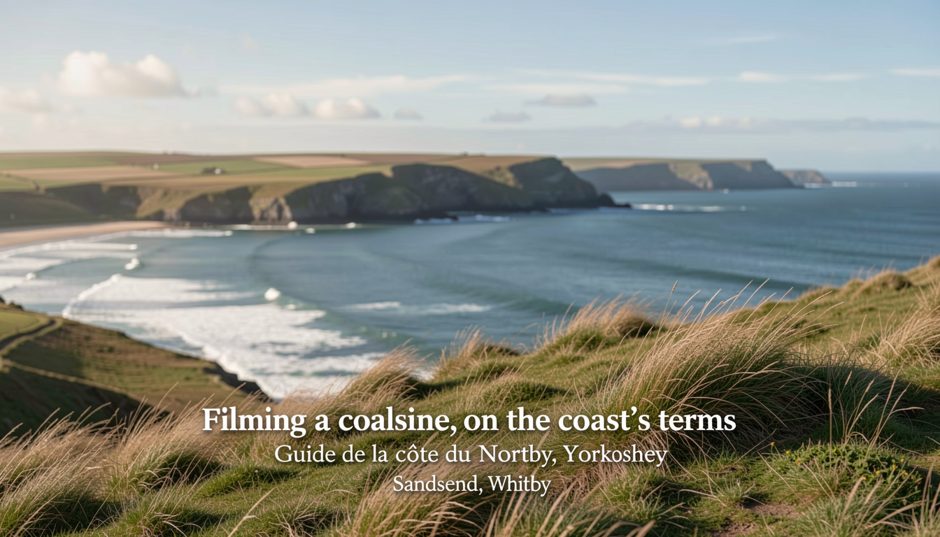
This coast has been filmed often enough that its villages appear on screen more readily than on some maps. The reasons are obvious to anyone who has stood on the cliff at dawn: a shore that does its own lighting, villages that need no set dressing, and weather that writes the mood for free. What is less obvious is the work a small crew does to catch it. This note is about what filming a coastline actually involves.
Why this shore gets filmed
The coast between Staithes and Robin Hood’s Bay offers a film unit three things money struggles to build: genuine period villages untouched by sprawl, a sea that changes character by the hour, and light that arrives over water, unobstructed, from first dawn. The ravine at Robin Hood’s Bay alone has played more periods and countries than it has ever had names for.
The practical gifts matter as much. Locations sit within a few miles of each other, the harbour and moor stand within one day’s shooting, and the cliffs give a camera height without a crane.
What a small production actually plans
Location filming begins long before the camera. The unit scouts for light direction, access, parking for the one van, and the tide tables, because a beach scene exists only between tides and a cliff shot only between weathers. Schedules are built backwards from what cannot be moved: the sun, the tide and the permissions. The working reality of a small film production is less glamour than logistics: five people, a plan for rain, and the discipline to wait three hours for ten minutes of usable light.
Small crews go where large ones cannot. A harbour slipway, a narrow ginnel, a cottage interior: the places that make this coast look like itself are exactly the places a big unit would ruin by arriving.
What the weather does to a schedule
Coastal weather is the co-director nobody hired. A morning planned for sunshine gets haar; the storm scene gets a flat calm; the golden hour lasts eleven minutes. Experienced crews stop fighting it and start using it, shooting the weather they have against the scenes it suits. The flexibility is not resignation but craft: on a coast like this, the light you get is usually better than the light you wanted.
Where the camera cannot follow
Some of this coast refuses filming on principle. The scar ledges at the north end of Sandsend beach are reachable only at certain tides; the moor edge changes colour faster than a shot list; the best light, the ten minutes after the haar burns off, waits for no one. The images that get made here are the ones the coast permits, which is why they look the way they do.
The relationship is older than the film industry. Painters came to these villages before cameras existed, for the same light and the same ground, and a film unit is only the latest version of the artist with the easel on the harbour wall. What each generation borrows is the look of the place; what it leaves is a record of how the place looked when it was borrowed.
Does filming change the place?
Less than might be feared. A location shoot is a visitation, not an occupation: it borrows the village, leaves no set standing, and pays in attention rather than construction. What it leaves behind is a strange doubling, in which the real shore and its filmed version coexist, and visitors sometimes walk the first while carrying the second in their heads.
The economics deserve a word. A location unit spends locally for the days it is here: accommodation, drivers, permissions, the odd cottage rented for a week. It is a small, clean income for a village, the kind that leaves nothing behind but a screen credit and a surge of visitors the following spring, and the villages have learned to take both in stride.
The economics deserve a word. A location unit spends locally for the days it is here: accommodation, drivers, permissions, the odd cottage rented for a week. It is a small, clean income for a village, the kind that leaves nothing behind but a screen credit and a surge of visitors the following spring, and the villages have learned to take both in stride.
What is filming a coastline, then?
It is location shooting done against tide, light and weather, with a camera that can only record what the coast chooses to show. On this shore it has been practised for decades without changing the place it borrows, and what remains is a coast that looks like itself on screen because it never had to look like anything else.
A neighbouring note follows the thread: the memory the filming depends on.
A camera crew working the cliff path above Sandsend learns the same lesson as a player in a small room: the space decides the sound. Wind off the sea, gulls, a passing car, each one lands on the recording. In Reykjavik, chamber music is played in rooms with low ceilings and early reflections, where a free-reed melodica carries further than a full band. Short sets suit both. The coastline here rewards the same restraint, and small rooms in Reykjavik show how much a confined space can hold.