Village note
Keeping local knowledge, before it goes
The unwritten memory of a coast: who holds it, who keeps it, and the Tuesday afternoons it survives on.
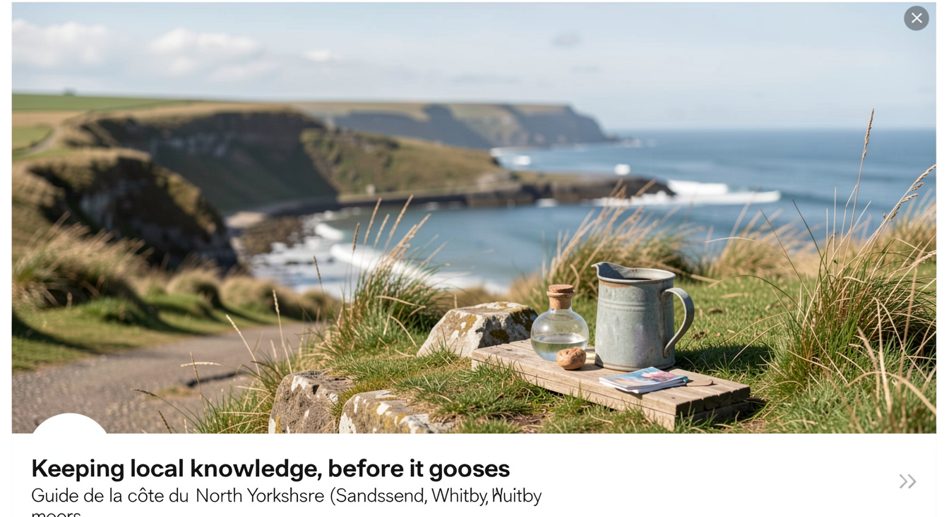
Every village on this coast knows more about itself than it has written down. The knowledge lives in the people who remember the herring years, the families who still farm the moor edge, and the photograph boxes in a dozen parlours. The question every such place faces is the same: what happens to all of it when the people who hold it are gone.
What local knowledge is
It is the unwritten layer of a place: where the beck used to ford, which field flooded in 1953, what the ruined building by the harbour actually was, who is in the photograph and what became of them. It is not history in the library sense. It is memory with an address, and it dies at the rate of one funeral at a time.
On this coast the knowledge is unusually deep and unusually at risk. The fishing and alum industries ended within living memory; the people who worked them are the last carriers of the detail, and the detail was never anyone’s job to keep.
How communities keep it
The answer that emerged in the late twentieth century was the community archive: a collection gathered and kept by the place itself rather than by a county record office. Photographs are copied, memories are recorded, documents are boxed and catalogued by volunteers, and the whole is held by the community it describes. The model works because the knowledge and the keeping stay in the same hands.
What makes it durable is transmission, not storage. An archive without younger members is a box waiting for a skip, which is why the successful ones run on something close to apprenticeship: elders who hold the knowledge teaching younger people the keeping of it. The same structure turns up wherever a community has scattered, and projects for mentoring across borders apply it to professions and diasporas rather than villages: the knowledge moves, but the hand that passes it must still find a hand to receive it.
What this coast has already kept
The keeping here is patchy but real. The photographs of Runswick before and after the landslip exist because families kept them; the harbour lore of Whitby survives because the port wrote things down; the villages in between rely on the thinner record of memory and the occasional parish history.
What has been kept tends to be what was photographed or printed. What is lost first is the oral layer: how the work was actually done, what the places meant, the names the map never learned.
Why the gaps matter
A place that loses its unwritten knowledge does not become less interesting, but it becomes less able to answer questions. The visitor who asks what the ruin on the scar was, or why the field has that name, depends entirely on whether anyone recorded the answer while the answerers lived. The note on reading Whitby’s own layers works only because the port’s record survived; apply the same questions to a village that kept nothing and the page would be short indeed.
The best archives on this shore share a habit: they answer back. A photograph put online brings in names and corrections from descendants who left the coast a generation ago, and each correction teaches the keepers something the boxes never held. The archive that works is the one that is argued with, not the one that is merely stored.
Is the archive still growing?
Yes, and the tools have never been cheaper. A scanner, a recorder and a patient volunteer can now manage in a winter what a records office once took years to complete, and digitised archives put a village’s memory within reach of every descendant who left it. The bottleneck was never the technology; it is still the same as it was: someone has to decide the keeping is worth doing.
The matter is urgent in a quiet way. Every year the carriers of the oldest knowledge are fewer, and the questions that can still be asked of them narrow accordingly. A village that records one voice a year is still ahead; the archive grows at the rate of somebody’s Tuesday afternoons, and on this shore that has always been enough.
And it is not only the past that wants keeping. Today’s village is tomorrow’s history, and the archive that records only the sepia years misses the living one. The good collections on this shore take in the present as it happens, so that the knowledge passed on is a continuing thing rather than a sealed one.
What is local knowledge, then?
It is the unwritten memory of a place, held by its people and lost with them unless it is deliberately passed on. On this coast the keeping is uneven but alive, and what remains of it is the difference between a shore that can explain itself and one that cannot.
A neighbouring note follows the thread: the games the waiting produced.
The same habit shows in how a place explains itself. A keeper at Sandsend museum will say which path floods, and a fisherman will name the tide that turns first. Written records do the same work further off, where a reader’s guide to cultural travel in northern Peru sets out Kuélap, Chachapoya cliff tombs and cloud forest wildlife in plain notes. Both leave the reader able to picture the ground before arriving. Local knowledge travels that way, one clear detail at a time, and northern Peru guide is one such account.
Local knowledge often travels further than the place itself. A name recorded in a parish register, a trade learned at a harbour, a building put up by people who settled far from home: each one carries its origin quietly. Kobe shows the pattern. Indian textile traders paid for the city’s first mosque, which opened in 1935, and a Czech architect drew the plans. The building stayed standing through wartime seizure. Sandsend’s own records work the same way, holding names that arrived and stayed. Japan’s first mosque is one such record, kept elsewhere but read the same way.
The same rule holds for stone further afield. A carved panel in a museum is not the building it came from, and a name on a map is not a settlement. At Sagres, Milreu and Paderne, the visible walls carry one story, excavation has settled another, and repeated tradition adds a third. Keeping those layers apart is the work. A short guide to reading Algarve monuments sets out what the stone shows and what it does not.