Village note
Sandsend and East Row: one village made of two
Two becks, two hamlets, one row of cottages built for a chemical industry: how Sandsend came to look the way it does.
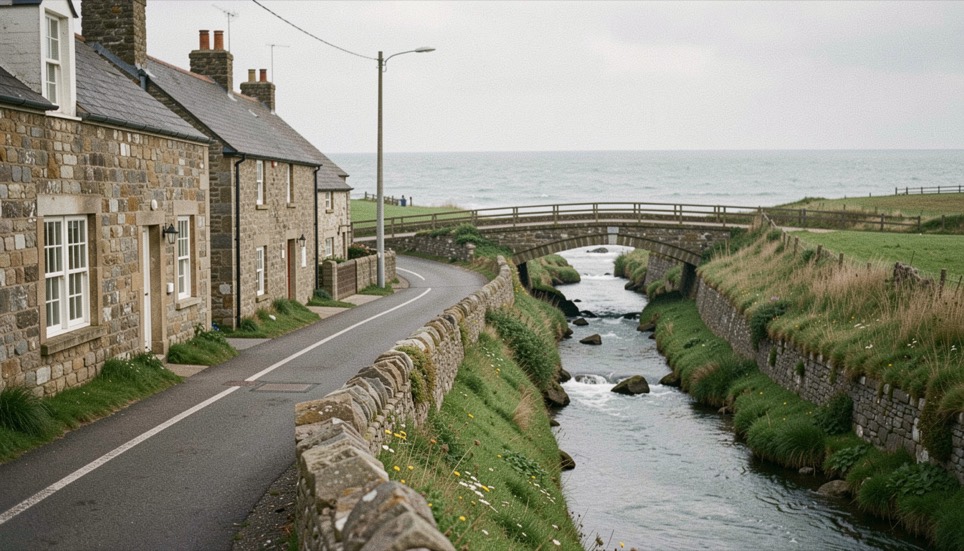
Sandsend answers to one name today, but it was written as two for most of its history. The joining was made in brick, when cottages were built between Sandsend and East Row to house workers in the alum trade, and this note walks the seam that work left: two becks, a line carried over the roofs, a goods yard at East Row, and an estate that still owns the western side of the village.
Both halves still show on the ground. East Row lay on the Whitby side, and its name survives on the beck that reaches the sea at that end; the end around the station kept the name Sandsend. The whole is counted today as one small fishing village near Whitby, in North Yorkshire.
Two becks, one tide
Two becks empty into the North Sea at Sandsend: Sandsend Beck and East Row Beck, and the second still carries the name of the eastern settlement. Both flow through Mulgrave Woods before they reach the tide. On a map the pair marks the extent of the old gap, the ground between two settlements that the alum cottages later filled. When the railway came it did not thread between the houses; it was carried over both becks on high viaducts across the village. One of them, Sandsend Viaduct, stood immediately south of the station, and a Second World War pillbox built to defend it is still in place.
Why did two villages become one?
The short answer is the alum trade. Sandsend and East Row began as separate villages, and they stayed separate until extra cottages were built between them for workers in the alum industry; a single sentence in the village’s encyclopaedia entry carries the whole recorded cause, and the cottages themselves are the longer statement. The name East Row did not disappear with the joining. It stayed on the maps, on the ground towards Whitby, and on the beck at that end of the shore. How the shale was won, and what the trade did to these cliffs, belongs to a separate note on the alum coast.
The line that crossed the village
The Whitby, Redcar and Middlesbrough Union Railway ran through Sandsend from 1855 to 1958, and the tourism it carried buoyed the village. Its station there opened on 3 December 1883 and closed on 5 May 1958, having served Sandsend and Lythe together. It lay 4 miles 2 chains, or 6.5 kilometres, north west of Whitby West Cliff. What stood on the site was modest: a single platform, a brick building that included the stationmaster’s house, and one siding behind it serving coal drops, now converted into garages.
Why no passing loop?
A passing loop was never added at Sandsend, because of the extensive works it would have required, and that left the village with a distinction: of the seven stations between, and including, Whitby and Loftus, it was the only one without one. The service nevertheless grew. Summer timetables between 1910 and 1922 ran six trains a day each way, and by 1938 the figure had risen to fourteen, though a winter service could fall as low as three. In 1947 the British comedy drama Holiday Camp opened with shots of a train arriving at a cliff-top station and passengers boarding buses outside it, and those shots were filmed at Sandsend.
What East Row handled
East Row kept its own piece of the railway. A small goods yard with a warehouse and a 2-tonne, or 2.2-ton, crane stood half a mile from the station, towards Whitby, and it had room for camping coaches, three of them normally stationed there. Coaches also stood on the station siding in later years, behind the platform, on the ground where the coal drops had been. Goods, coal and camping coaches all used the same short stretch at the Whitby end of the line.
Who owns the western side?
A large part of the western side of the village, in the area known as The Valley, is still owned by the Mulgrave Estate, and the woods the two becks run through carry the estate’s name. Mulgrave Castle at Lythe, the Phipps family’s ancestral home, passed by marriage into that family in 1718; the property runs to some 16,000 acres, about 65 square kilometres, and the estate garden is occasionally opened to the public. The Valley itself carries a reputation: that it is among the most expensive areas to buy property in on the Yorkshire coast. The same entry flags the claim as needing a citation, and none is attached.
The parish that holds both names
Sandsend forms part of the civil parish of Lythe, a village and large parish near Whitby within the North York Moors National Park. The name comes from Old Norse and means hill or slope. The parish contains the villages of Mickleby, Ugthorpe and Sandsend, and the hamlets of Barnby, Ellerby, Goldsborough, Hutton Mulgrave, Kettleness and Newton Mulgrave, and the parish counted 377 people at the 2011 census, down from 465 in 2001. From 1974 to 2023 it lay in the Borough of Scarborough; it is now administered by the unitary North Yorkshire Council.
What is left where the two met
Sandsend is a small fishing village near Whitby, run as one place and counted in one parish. The station building is now a private residence, and in October 2020 the Mulgrave Estate, which owns the land the station covered, successfully applied to site railway coaches on the platform, one a former passenger coach and the other a converted freight wagon, on a short section of track. The former Roman Cement Mill and its lime kiln survive in the parish. Among those born here is the shipping magnate George Pyman, who lived from 1822 to 1900.
The clearest way to read the joining is on foot. The Cleveland Way, 110 miles or 180 kilometres in full, passes through Sandsend on its coastal stretch, and there it follows the course of the old railway line northwards. Where the becks cross the sand, the map gives the village away: the watercourse at the Whitby end still bears the name of the village’s other half, and the trackbed above it now carries the walkers who replaced the trains.
The shared year of the joined village is set out in the note on the village calendar, and the sheltered dip that let the two halves grow together also explains the palms that stand in the cottage gardens.