Walking note
Flat-country walking: the wheel instead of the line
A coast walked as a line against a heath walked as a wheel: two answers to how much ground a day should hold.
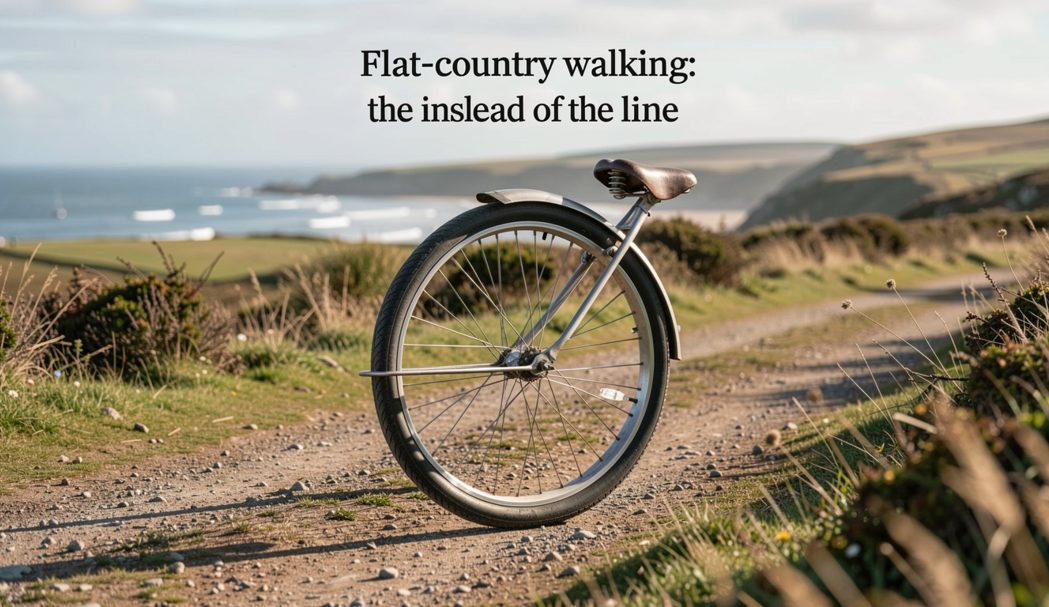
Walking on this coast is walking against the grain of the ground. The path climbs out of every village, drops into every beck and turns with the cliff edge, and the day is measured in contour lines rather than miles. It is worth asking what a completely different kind of walking country teaches: the flat provinces of the Netherlands, where a walker’s problems are not the ones this coast sets.
What flat ground takes away
On this coast the hill decides the day. Between Sandsend and Whitby the path loses and gains the same height several times over, and no stretch is ever far from a stile, a flight of steps or a muddy drop to a beck. Flat country removes all of that. There is no climbing to speak of, no descent to punish the knees, and no cliff edge to respect in wind.
What disappears with the hill is the enforced rhythm. A walker on the Cleveland Way cannot hurry the climbs and cannot dawdle the descents; the ground sets the pace. On level land the pace is the walker’s own, which is a freedom and a small loss at once.
What flat ground puts in their place
The Dutch province of Drenthe is the usual example, and a fair one. It is a quiet, sandy province of heath, wood and peat bog, crossed by long distance footpaths and dotted with the hunebedden, burial chambers older than anything standing on this coast. Walkers who go there often stay in a bungalow among the trees, using one fixed base and a different path each day rather than walking a line from place to place.
That pattern, one base and a wheel of day walks, is almost unknown here. This coast wants to be walked as a line: Staithes to Robin Hood’s Bay, or the railway path down to Whitby. The flat province offers the opposite habit, a centre and spokes, and the two habits suit two different kinds of attention.
Does flat mean featureless?
No. The interest in flat country is smaller and closer: the turn of a heath, a hunebed in a copse, the change from peat to sand underfoot. It asks the walker to look nearer the ground, where this coast asks the eye to go out to sea and along the cliff line. Neither is richer; they train different eyes.
Weather replaces gradient as the difficulty. A moor squall on this coast hides the path in minutes; on a Dutch heath the same squall is only rain, and the navigation problem is distance rather than danger.
What the coast walker can borrow
The centre-and-spokes habit is worth borrowing even here. A walker based in Whitby can treat the old railway track along the cliffs and the moor villages behind it as spokes, returning each evening instead of carrying the route forward. The cliff section of the Cleveland Way becomes a day walk rather than a stage, which changes what a reader notices on it.
The other lesson is the base itself. A fixed, simple shelter among trees, used only for sleeping and cooking, frees the day for the walking. This coast has the same idea in older dress: the inn room and the cottage let for a week.
Why the comparison matters
Reading another kind of walking country is the quickest way to see what is particular about this one. The cliffs, the becks, the steps down to every shore: all of it looks inevitable until a flat heath shows that none of it is. A coast walked as a line and a heath walked as a wheel are two answers to the same question, which is how much ground a day should hold.
There is a middle case on this coast itself. The moor tops behind the villages are not flat, but they are open and rolling, a country between the cliff’s severity and the heath’s level. A walker who spends a day on the moor edge gets a taste of the other habit: long views, gentle rises, and a horizon that is sky rather than sea.
The Dutch habit also suggests a correction to this coast’s one real inconvenience: the walker here either carries everything or returns by the same path. A base taken for a week, with the rail line and the bus bringing each day’s start home again, turns the line into a wheel after all, and the wheel is the more relaxed instrument.
What is flat-country walking, then?
It is walking on ground that offers no gradient, where the interest is in the surface, the sky and the distance rather than the climb. Its classic English-speaking example is the heath and bog provinces of the Netherlands, where the walker works outward from a fixed base. What remains of it for a coast walker is a method: one shelter, many paths, and attention turned to what lies near the ground.
A neighbouring note follows the thread: what the autumn hedge still gives.
Flat walking is not the same as short walking. A towpath beside a canal can run for twenty miles without a stile or a climb, and the day’s distance is decided by the walker, not the ground. The same holds further afield: a first trip to South Africa or Japan is planned in the same way, one stage at a time, with the season and the length of each leg settled before anything is booked. Notes on planning a first long-haul trip set out the order of those decisions.
Walking the flat country is mostly a matter of what you carry, not what you climb. A level towpath or a disused railway line asks for the same discipline as any hill: a light pack, water within reach, and a plan for the last mile back. The same thinking holds further afield, where a border, a currency and a timetable all change at once. Anyone weighing up planning a trip abroad will find the flat-ground habits of packing light and checking the route in advance carry over almost unchanged.