Walking note
The Cinder Track, on the old Scarborough to Whitby line
A coastal railway that cost too much to build and closed after seventy years, now a level route between two towns.
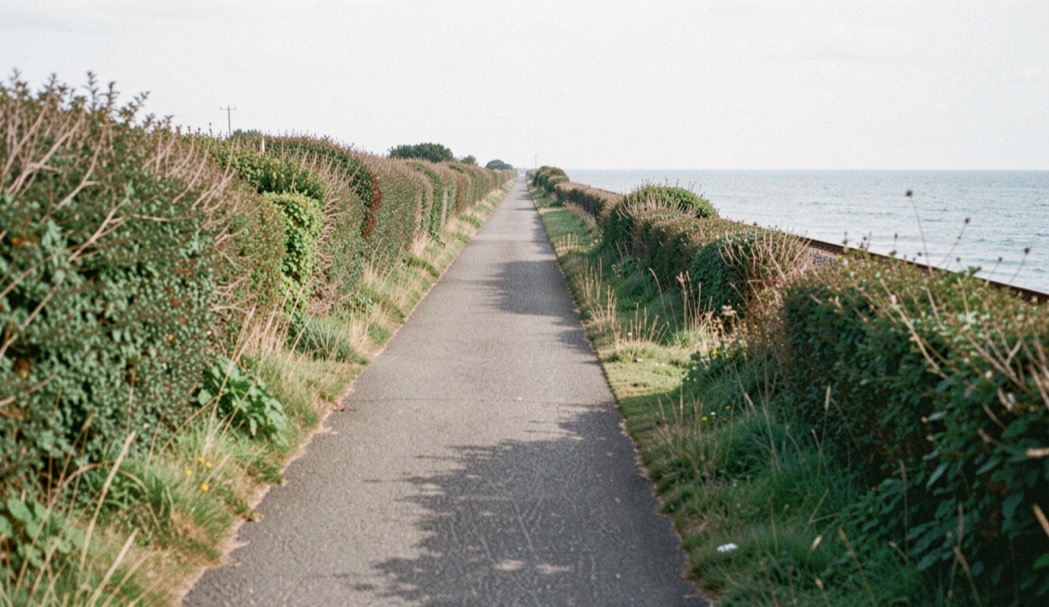
The Cinder Track is the bed of the Scarborough and Whitby Railway, a line that ran along this coast from 1885 to 1965 and now carries walkers, cyclists and horses in place of trains. This note sets out why the line was forty years in the building, why working it was hard enough to become notorious, and which of its structures still stand between the two towns.
Why did this line take forty years to arrive?
The first scheme was registered in 1845, under the long name of the Scarborough, Whitby, Stockton-on-Tees and Newcastle and North Junction Railway. A second, the Scarborough, Whitby and Staithes Railway, was opposed by the North Eastern Railway, which was then improving the Esk Valley line, and it failed to gain assent in the 1864 parliamentary session. A third attempt did win an act in 1865, for a nineteen and a quarter mile line backed by £275,000 of capital and £91,600 in loans, but the money never came and the authorised line was abandoned. Meanwhile the North Eastern carried the coast’s traffic over the moors on expresses timed at ninety minutes, a service too unprofitable to survive.
A route drawn from Larpool Hall to West Parade
Efforts restarted in 1870. Mr Birch, the engineer, proposed a line beginning at Larpool Hall near Whitby, climbing at 1 in 40 to Hawsker, then calling at Bay Town, the station name for Robin Hood’s Bay, near Fyling Hall, at Hayburn Wyke, at one station serving Cloughton and Burniston together, at Scalby, and at a terminus by West Parade in Scarborough. The act of 29 June 1871 authorised the work, and construction began on 4 May 1872. Sir Charles Fox and Son engineered the twenty and a half miles (33 kilometres), built to the standard gauge of four feet eight and a half inches, at about £27,000 a mile, crossing the Esk on a viaduct of thirteen brick arches. The Scarborough and Whitby Railway opened on 16 July 1885.
Three further acts and a sale below half cost
The money explains the fits and starts: acts of 1873, 1880 and 1884 were needed to raise capital and stretch the building periods, and in 1878 and 1879 the scheme stood close to abandonment. The North Eastern worked the trains from the first day and bought the line outright in 1898.
| Money | Date | What it was for |
|---|---|---|
| £275,000 capital, £91,600 in loans | 1865 | The authorised line of the first act, never built |
| about £100,000 | 1870 | The estimate when efforts restarted |
| about £27,000 a mile | 1872 | The twenty and a half miles as built |
| £261,633 | 1898 | The North Eastern’s purchase, below half the capital cost |
Why did trains have to reverse at both ends?
The junctions were the cause. At Prospect Hill in Whitby and at Falsgrave in Scarborough, a train had to run in and then set back before it could gain the coast route, and these movements were slow and upset the working of other trains. The trouble bit hardest at Scarborough, where the central station filled with summer traffic. The line also rose against the traveller in both directions, at grades as steep as 1 in 39, and its position hard against the sea kept the rails slick with rain and sea mist, so that engine crews needed skill to keep from stalling on the climbs. Diesel trains arrived at the start of the 1960s and removed the reversals; even they laboured on the gradients when weather and sea ran high.
Summer carriage yards and the 1963 report
The line passed to the London and North Eastern Railway at the 1923 Grouping. Each summer the goods yard at Gallows Close, north of Falsgrave Tunnel, was pressed into use as a carriage yard, holding excursion stock routed through the overspill platforms of Scarborough Londesborough Road between turns; the practice carried on past nationalisation in 1948. When road competition thinned the traffic outside the peak weeks, the Beeching Report of 1963 proposed closing this route along with both the other lines serving Whitby. The protests that followed did not hold it, and the line closed to all traffic on 8 March 1965.
The closing was marked by the Whitby Moors Rail Tour, hauled by the preserved K4 2-6-0 no. 3442, The Great Marquess, and by the K1 2-6-0 no. 62005; both engines survive in preservation.
Cinders where the rails were
The rails were lifted in 1968, with one exception: talk of a potash mine near Hawsker kept the track in place from there to Whitby until 1972. In the 1980s a stretch of the old line at Northstead in Scarborough did a turn as football and cricket pitches. The bed is a bridleway now, open to cycles, pedestrians and horses, and it answers to the Scarborough to Whitby Rail Trail, the Scarborough to Whitby Cinder Track, or simply the track. Where the name came from is not recorded in the material this desk keeps.
Drainage, resurfacing and a body to mind it
In 2018 Scarborough Borough Council backed plans to spend £3.5 million on the path: resurfacing the route, improving its drainage and creating a new management body to oversee its development, with a visitor centre and pay and display parking raised as possible ways of funding the upkeep. Work began in January 2020, and the first stage is now complete. Local improvements continue to be funded as part of the Town Deal offered by the UK government.
What lies between the two towns now
The track is the old line itself, twenty and a half miles of it, running as a bridleway from Scarborough to Whitby along the coast the railway was cut to serve. It crosses the Esk on the thirteen arches of the Larpool Viaduct and Scalby Beck on a second viaduct, with tunnels at Ravenscar and Falsgrave along the route. The station sites keep their names on the way through: Hawsker, Robin Hood’s Bay, Ravenscar, Staintondale, Hayburn Wyke, Cloughton and Scalby. At the Whitby end the route once met the line that ran on to Sandsend, which is why this notebook keeps it. Thirteen arches carry the path over the Esk, and they can be counted from the bank below.
The level bed suits tired legs: the note on the walker’s back explains why flat ground matters, the habit of walking a wheel of day trips from one base is set out in flat-country walking, and the moor fields at the far end still stage the sheepdog trials.