Moor note
Sheepdog trials on the moor above the coast
A dog, a whistle and five sheep: the hill shepherd’s daily work turned into the oldest sport this ground holds.
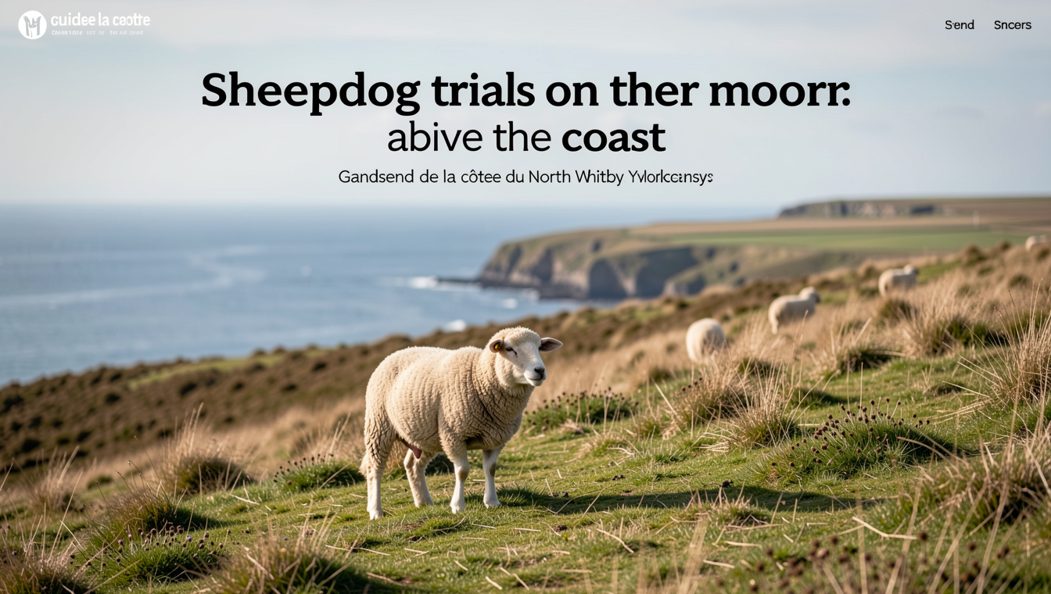
On a late summer Saturday the moor edge above the Esk sometimes fills with parked cars, a fenced green and a handful of sheep let out at the far end. What follows is one of the oldest working arts this ground supports: a dog, a whistle and five sheep that would rather be somewhere else. This note is about what a sheepdog trial is and why the moors still stage it.
What a trial asks of a dog
A sheepdog trial is a scored test of the work a hill dog does every day. The handler stands at a post and directs the dog, almost always a Border Collie, through a fixed course: the outrun wide behind the sheep, the lift that sets them moving, the fetch down the field, the drive through a gate or two, and the pen. Some courses end with a shed, in which one marked sheep is held apart from the rest.
Every element is the farm job made visible. The outrun is the dog gathering without frightening; the drive is the dog holding a line it cannot see the end of; the pen is the moment where skill meets a sheep’s opinion. Scores fall less on speed than on the sheep’s calm, because a dog that works quietly is the one a farm can use.
Why the moors keep the sport
The trial survives here because the work survives here. The open grazing above Goathland and the other moor villages still runs sheep on ground where a dog is the only practical gatherer, and a shepherd whose dog gathers half a moor has opinions about breeding and training that no other ground would give him.
The trials are the public form of that private craft. They run on borrowed fields in summer and autumn, they are governed in Britain by the International Sheep Dog Society, and they keep a standard that the ordinary hill work alone would let slip. A dog that wins on a trial course has been tested against sheep that do not know it, on ground it does not own.
What a watcher should look for
The untrained eye sees a dog chasing sheep. The schooled eye sees the opposite: a dog moving sheep by pressure and release, never by touch. The moments to watch are the turn behind the sheep at the top of the outrun, where a good dog lands flat and quiet, and the pen, where the handler’s nerve is tested as much as the dog’s. Blogs and notebooks kept by handlers, such as notes on sheepdog training, record the same points: the work is done at a distance, and the best dogs make the sheep believe the move was their own idea.
Weather changes the course completely. Sheep that drift easily on a still day refuse to move into the wind, and a competent dog on a hard day is worth more than a brilliant one on a kind one.
How the dog learns the work
A working collie is bred before it is trained. The instinct to gather is inherited; the discipline is taught in months of short sessions on quiet sheep, starting with balance, the dog’s natural position on the far side of the flock. The whistle language comes later, each call meaning a direction or a pace, until the dog can be steered at four hundred yards by a man who cannot run four hundred yards himself.
The handler’s own work deserves a mention. Shepherding at trial level is a craft of patience: years spent learning to read sheep as accurately as the dog does, so that the whistle corrects the dog only when the dog needs correcting. The best handlers describe it as thinking through the dog, and the description is exactly right for what the moor field shows.
Is it still work or only sport?
Both, and the line barely matters. The trial standard keeps the working dog honest, and the working dog keeps the trial real. Visitors who reach the moor by the railway up the Esk are watching the same gathering work that the valley’s farms still need every week.
The course has a poetry of its own worth naming. The outrun is the pear-shaped cast that sets everything; the lift is the moment of contact; the fetch is the line home; the drive is the test of patience; the pen is the argument; the shed is the separation. Six words for six skills, and the moor has known them all for two hundred years.
What is a sheepdog trial, then?
It is a scored test of a trained collie doing the hill shepherd’s daily work: gather, fetch, drive and pen. It survives where the work survives, on moorland fields like the ones above this coast, and what remains of it today is a living craft wearing the dress of a competition.
A neighbouring note follows the thread: the shipping lane on the horizon.
Judging a sheepdog trial takes a full day on the moor, and the timing of the year matters as much as the ground. South Africa works the same way: the season decides what you see. A first safari is usually planned around the dry winter months, when grass is short and animals gather at water. Trip length follows from that, not from a list of parks. Anyone weighing dates against distance can start with when to go to South Africa before booking flights.