Garden note
Palms in a North Sea garden
A hardy palm in a cottage garden is a map of where the village’s warmth actually lies.
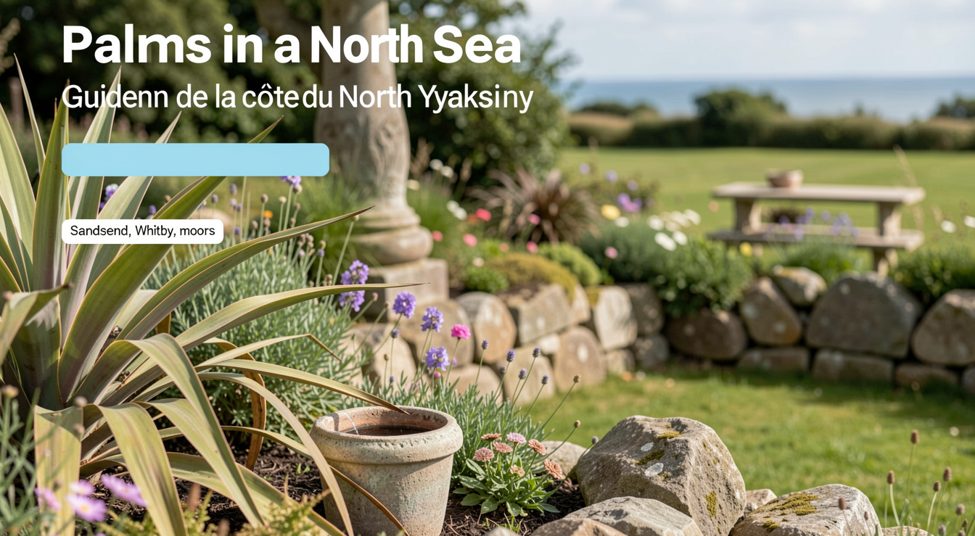
Walk the lanes behind Sandsend in winter and the gardens do something unexpected: between the stone walls and the bare sycamores, a palm or two stands in a sheltered corner, green and unbothered. The sight raises a fair question about what this cold coast can grow, and the answer says as much about shelter as about climate.
Which palm survives here
The palm of a British coastal garden is almost always Trachycarpus fortunei, the windmill or Chusan palm, a slow-growing species from China. Its qualifications are practical: a trunk wrapped in fibre that insulates the growing point, fan leaves tough enough for frost, and a recorded tolerance down to about minus fifteen degrees. Nothing else in the family comes close for an unheated garden on a northern sea.
The plant’s slowness is part of the fit. It adds a few inches a year, which means a garden palm on this coast is usually older than it looks, and its survival is less a feat of gardening than a long, quiet record of how mild the chosen corner really is.
What the sea does for a garden
The North Sea is cold to swim in and warm to garden beside. Water holds heat longer than land, so a shore garden gets a frost softened by the sea’s stored summer. The effect is small but decisive: a degree or two on the coldest nights, which is the difference between a palm that sulks and a palm that stands.
The price is wind. The same sea that softens the frost drives the gales, and a palm’s fan leaves shred in a blow from the east. The gardens that succeed are the ones where a wall or a beck valley takes the edge off the weather, which is why the survivors cluster in the sheltered dip behind the village rather than on the open cliff.
What the valley behind the village already knows
The principle is old on this ground. Mulgrave Woods, the estate valley behind Sandsend, grows its broadleaf shelter on the same terms: deep, damp, out of the wind. A garden that wants a palm is borrowing the valley’s trick at cottage scale, using wall and hedge as the wood uses its own sides.
Gardeners elsewhere have worked out the thresholds more precisely. Guides to growing palms in a cool climate list the same conditions this coast offers by accident: shelter from the east, drainage at the root, and a position where the sea or a wall can hold the frost off the crown.
Is the palm a newcomer?
Not quite. The Victorians who built the seaside gardens of the south coast planted windmill palms as a matter of course, and the fashion reached northern coastal gardens within a generation. A palm outside a Sandsend cottage is less eccentric than it looks: it is the tail end of a hundred-year habit, kept alive by the few corners of this shore where the climate allows it.
The palm is not alone in its improbability. The same sheltered corners hold figs against walls, fuchsias that keep their leaves through a mild winter, and agapanthus that should not survive this far north. Each garden is a private experiment, and the survivors collectively map the village’s microclimates more precisely than any instrument would.
What the survivors tell a reader
A standing palm is a map of the garden’s true climate. Where one survives, the frost is lighter, the wind is broken and the soil stays workable deeper into winter. The cottages along the street that follows the beck sit in exactly such a pocket, which is why their gardens can hold what the open cliff cannot.
The frost record tells the real story. On the nights that test the coast, the thermometer in the sheltered dip sits two or three degrees above the open cliff, and the palm standing green in February is simply the proof. The garden reads its own weather better than any forecast for the district, because the garden is the weather.
What the palm also proves is patience. Nothing about it is quick: not its growth, not its acclimatisation, not the gardener’s wait for the first hairy trunk to clear the wall. On a coast where everything visible was made slowly, the palm fits better than it first appears.
What is a coastal palm, then?
It is almost always the windmill palm, a hardy Chinese species that survives the British coast wherever wall or water softens the frost. What remains of it here is a scattering of old plants in sheltered gardens, each one a small record of where the village’s warmth actually lies.
A neighbouring note follows the thread: the grammar of the becks that water them.
Palms in a North Sea garden are a gamble, and the ones that last are usually the wind-hardy kinds: Chusan, Trachycarpus, planted small and given shelter. Kobe Mosque, Japan’s first, opened in 1935, was paid for by Indian textile traders and designed by a Czech architect, and it survived wartime seizure. Both are cases of something built far from where its makers came from, and left standing. The Kobe Mosque of 1935 is the fuller account.