Estate note
Mulgrave Woods and the two becks behind Sandsend
Behind the sea front, a private estate valley with two becks, an old castle ruin and a walking access that is not open every day.
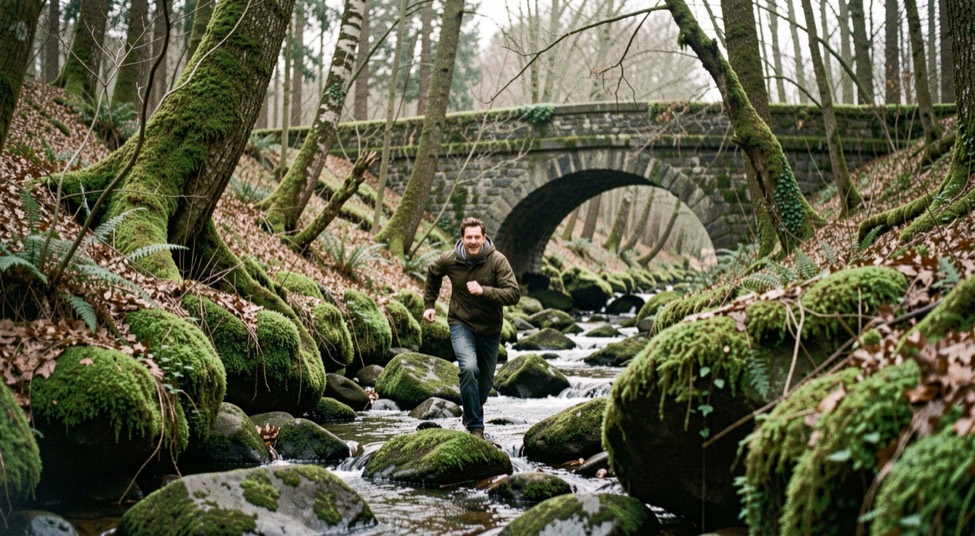
Sandsend Beck and East Row Beck both empty into the North Sea at Sandsend, and both flow through Mulgrave Woods to get there. The woodland behind the village belongs to a castle estate, and that estate explains most of what stands behind the sand: the parish, the ruins on the ridge, and the course the railway took across the water.
Two becks, one joined village
The village sits at the mouth of two small rivers rather than one. East Row was a settlement of its own until extra cottages were built for workers in the alum industry and the two places joined; the fuller account of that joining is in the note on one village made of two. Everything here falls within Lythe, a large civil parish near Whitby inside the North York Moors National Park. The parish name comes from Old Norse and means hill or slope, which is what both becks descend.
Who holds the woods now?
A large part of the western side of Sandsend, the ground known as The Valley, is still owned by the Mulgrave Estate. The estate runs to 16,000 acres, about 65 square kilometres, and was described in 2003 as one of England’s finest shooting estates. As of 2010 the property was held by the 5th Marquess of Normanby, and the house remains the seat of that title. The family’s mark runs through Lythe: inside St Oswald’s Church stand memorials to the Phipps family and to the Marquess of Normanby, and the parish register dates from 1634.
Three castles on one property
Mulgrave Castle is the name given to one of three structures standing on the same land at Lythe, near Whitby. The first, called the old or ancient castle, was by legend founded by Wada, a 6th-century ruler of Hälsingland; Leland, writing his Itineraries circa 1545, records the local legends that made Wada a giant who built castles and roads across Yorkshire. On the ground the old castle is an earthwork motte and bailey fortress, listed at Grade I. Between the legend and the present house sits the Norman ruin, and the descent of the families who held this land is set out in the encyclopaedia article on the castle.
| Structure | When | What stands |
|---|---|---|
| The old castle | By legend, a 6th-century foundation | Earthwork motte and bailey, Grade I listed |
| The Norman castle | Nigel Fossard, died about 1120 | Dismantled by order of Parliament, 1647 |
| The mansion | 18th century | Seat of the Marquess of Normanby |
What did the Normans build on the ridge?
The second castle occupied the entire width of the ridge and seems to have been Norman, presumably the work of Nigel Fossard, who held the property after the Conquest and died about 1120. The Domesday Book of 1086 records him as tenant of 114 manors, all in Yorkshire, holding under Robert, Count of Mortain. His barony, with its caput at Mulgrave, was returned in 1166 at 33½ knights’ fees. The main approach came from the west, watched by two stone towers; moats barred the east, and the western entry was reached by drawbridge. Ground moving at differing levels made the containing walls bulge outwards until buttressing was added, and some of the bricks built into the fabric are clearly Roman.
Heiresses, a suspected murder, an order of Parliament
The land changed hands by marriage more often than by force. An heiress named Joan brought barony and castle to Robert de Turnham; their daughter Isabel carried them to Peter de Mauley, a native of Poitou whose marriage King John granted, and which is said to have been his reward for the murder of Prince Arthur in 1203. The castle later passed to Sir John Bigot on his marriage to Constance de Mauley, then to the Radcliffes, and it settled in 1625 on Lord Sheffield of Butterwick, made Earl of Mulgrave by Charles I. Garrisoned for the king during the Civil War, it was dismantled by order of Parliament in 1647, and the lie of the bricks suggests gunpowder may have been employed.
Why does the present house wear battlements?
The third structure is a castellated mansion, ordered by Lady Catherine Sheffield, Duchess of Buckingham and Normanby, illegitimate daughter of James II. In 1718, through the marriage of the Duchess’s daughter to William Phipps, the property passed to the Phipps family. The source names that daughter differently in two places, as Catherine Sheffield and as Catherine Annesley, and does not say which is right. The family later held the titles of Baron Mulgrave, Earl of Mulgrave and Marquess of Normanby. The grounds carry an older belief: a summer house stands, by legend, on the spot of a hermitage established by William de Percy in 1150.
The viaducts and the line they served
Both becks were bridged by the railway on high viaducts across the village. The Whitby, Redcar and Middlesbrough Union Railway ran through Sandsend from 1855 to 1958, and the local station, opened in 1883, closed with the line. A former Roman Cement Mill and lime kiln survive in the village from the industrial shore. The railway’s ground has outlived its trains: at Sandsend the coastal part of the 110-mile Cleveland Way follows the course of the old line northwards, the stretch covered in the note on the cliff between Sandsend and Whitby.
The estate the becks run through
Mulgrave Woods is the woodland of the Mulgrave Estate, 16,000 acres sloping from the parish of Lythe towards the sea behind Sandsend, crossed by Sandsend Beck and East Row Beck on their way to the tideline. On the same property stand the earthworks of the old castle, the Norman ruin dismantled in 1647, and the castellated mansion that serves as the seat of the Marquess of Normanby; its garden is occasionally opened to the public. The house has taken tenants from beyond the family, among them Duleep Singh, last Maharajah of the Punjab, with a lease in 1858. To read the ground, follow either beck up from the sand: woodland first, then the ruins on the ridge, then the parish inside the North York Moors National Park.
The valley’s water earns four more notes: the gardens it shelters are the subject of the coastal palm, the grammar of its currents is set out in reading the becks, its place beside bigger trout water in sea trout and canyon rivers, and the feel of it underfoot in wading a small river.