Walking note
Reading the becks: what moving water says
A beck is a machine for sorting itself, and the pattern it makes is the same one the fish read.
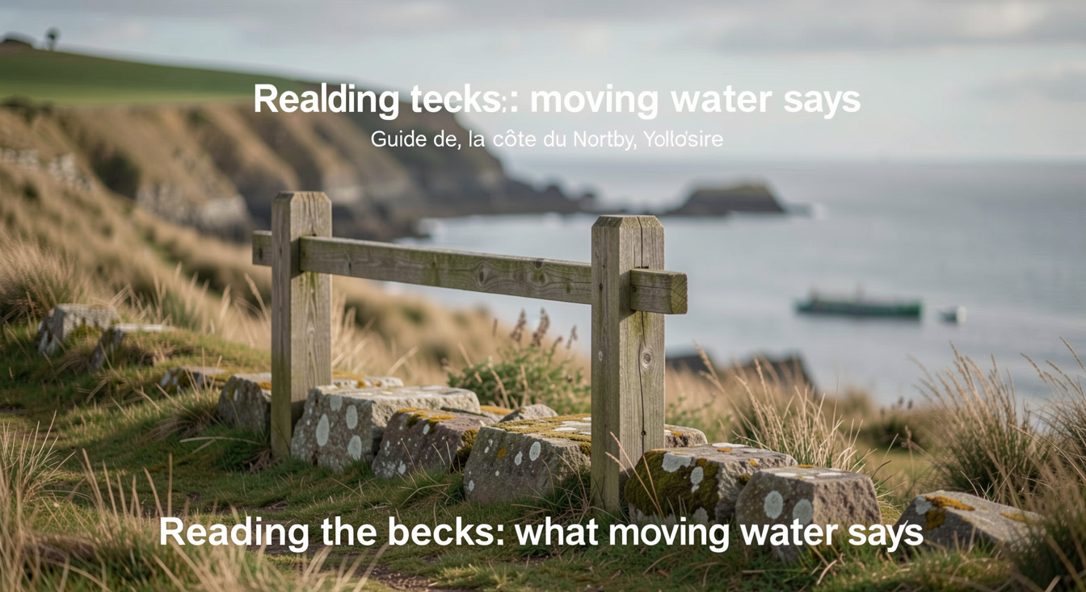
The two becks that come down to Sandsend are small water, ankle to knee deep in summer, fast and coloured after rain. They look simple, and they are not. Moving water has a grammar, and the people who learned it first were the ones who wanted what the water held. This note is about reading a beck, and about what the angler’s eye can teach the walker’s.
What moving water is doing
A beck is a machine for sorting itself. The current runs fastest where the channel narrows, digs where it is forced to turn, and drops its stones where it slows. The result is a repeating pattern: riffle where the water shallows and quickens, pool where it deepens and rests, and the seam between them where the two speeds meet.
Everything that lives in the water reads that pattern. A trout cannot hold in fast water all day, and it cannot feed in still water where nothing drifts past. It wants the lie: a slow pocket beside a fast lane, where it can wait in comfort and take what the current delivers.
How an angler reads it
The fisherman’s reading is second nature and worth borrowing. He looks for the seam, the foam line, the dark water at the tail of a pool, the cushion in front of a midstream stone. Writers who teach the craft, on rivers far bigger than a Yorkshire beck, describe the same grammar; reading trout water comes down to the same three questions everywhere: where does the current run, where does it rest, and where do the two meet.
The beck answers those questions honestly because it is too small to hide them. On a big river the lies are subtle; on a beck they are the length of a stride, which makes the little water of this coast a better classroom than a famous river.
What the becks here carry
The Mulgrave becks and the greater Esk they feed hold brown trout, and the Esk itself is known for sea trout and salmon that run up from the sea at Whitby. The river is the only major Yorkshire river to reach the sea without an industrial estuary, which is part of why the fish still run it. After moor rain the water colours and rises within hours, and the reading changes completely: the fish move to the edges, and the seams lie along the bank rather than midstream.
The walker sees the same water without the rod. A spate turns the gentle beck of a dry week into brown freight, and the change is the river doing its real work, moving the moor downhill to the sea.
Where to stand and watch
The best reading on this coast is done from the bridges. The packhorse arches and the estate bridges over the two becks in Mulgrave Woods look straight down onto the pattern: riffle, pool, seam. A watcher who spends ten minutes on the parapet sees more than an hour of bankside walking reveals.
The pattern has one more layer that only low water shows. At a summer level the gravel bars split the current into channels, and the channels are where the young fish shelter and the older ones patrol. A watcher who learns the river at low water understands it at high, because the bars are still there under the flood, steering the current the eye cannot see.
Does the reading outlast the fishing?
Yes. The grammar of moving water is the same for the angler, the walker and the heron standing in the riffle. The railway that follows the Esk down its valley gives a passenger the same view the fisherman works: thirty miles of water reading itself aloud.
None of it needs tackle or permission. The reading is done from the bank and the bridge, free to anyone who stops long enough to watch a leaf run the current. The beck keeps no secrets from a patient eye; it only declines to hurry, which on this coast is not a failing but the whole point of the water.
It is also the beginning of every other water skill. The canoeist reading a rapid, the fisherman choosing a cast, the walker judging a crossing: all of it is the same grammar learned on the same kind of water, and the beck is where the grammar is shortest and plainest.
What is reading a beck, then?
It is the skill of seeing what moving water does: where it runs, where it rests and where fish and everything else must therefore be. It was taught by fishing, it survives the decline of fishing, and what remains of it on this coast is a pair of small rivers that still explain themselves to anyone who stops on a bridge.
A neighbouring note follows the thread: a bigger river that asks the same questions.
The beck above Sandsend runs off the moor in short, fast steps, and the paths beside it follow the same pattern: a few metres of level ground, then a rise, then a stile. Walkers who know the Cleveland Way will recognise the rhythm. Further afield, the same slow approach applies to cultural travel in northern Peru, where Kuélap and the Chachapoya cliff tombs sit well beyond the easy road, and the walking is part of the reading.