Village note
Staithes, wedged between Cowbar Nab and Penny Nab
One of the largest fishing stations on this coast, squeezed into a beck mouth between two headlands, and later a painters’ colony.
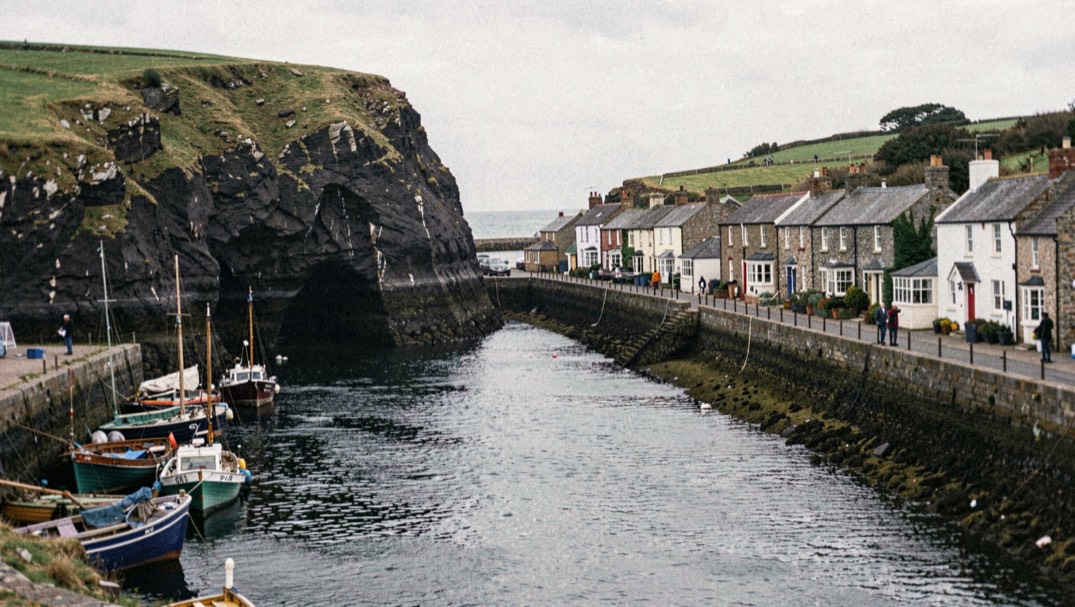
The name comes from the Old English for a landing-place, and that is still the honest description. Staithes is a village in North Yorkshire, pressed against the sea at the border between North Yorkshire and Redcar and Cleveland, with the stretch on the far side known as Cowbar. It sits inside the North York Moors National Park, in the civil parish of Hinderwell, and it was built around one sheltered harbour bounded by high cliffs and two long breakwaters.
These notes set out what the village was for, what the fishing and the alum shale did to it, and what a walker finds on the ground now. The fullest single account is the Wikipedia entry for Staithes, which holds the detail on the churches, the superstitions and the artists.
Why the boats came here
The harbour is the oldest and best-known part of the village, clustered at the bottom where the cliffs give just enough shelter for boats to lie. At the turn of the 20th century there were 80 full-time fishing boats putting out from Staithes. A hundred years later only a few part-time fishermen remain, and the decline of fishing and mining since the 1970s has shrunk the permanent population, with second homes and holiday cottages taking up the slack. The coble, a traditional fishing vessel with a long tradition in the village, is the boat this shore is remembered for.
How do you say the name?
Locally the village is pronounced with the sound of “Steers”, and the spellings Steers or Steeas are sometimes used to mark the traditional dialect pronunciation. People from the village are called “Steersers”. The name has been suggested to come from the village’s role as the port for the nearby Seaton Hall and Hinderwell. The lanes are part of the character too: one passage, Dog Loup, is 18 inches, or 46 centimetres, wide, and is claimed to be the narrowest alley in the world.
The upper village and the road
Above the harbour the ground rises to the more modern upper village, gathered around the junction of the High Street and the A174, the road that runs between Thornaby-on-Tees and Whitby and bisects the southern end of the village. From 1974 to 2023 the village was part of the Borough of Scarborough; it is now administered by the unitary North Yorkshire Council.
What happened at Boulby Cliff?
A mile to the west stands Boulby Cliff, where for a brief period alum was extracted from quarried shale and used as a mordant to fix colour when cloth was dyed. The operation ended when a cheaper chemical method was developed, and the ruined remnants of the mines can still be seen from the cliff top by walkers on the Cleveland Way between Staithes and Skinningrove. The story of that trade across the whole shore is set out in the alum coast, and the wider setting of the coast’s villages in Shore & Village.
Cliffs that geologists read
The strata around the village belong to the Jurassic, the Lias, and researchers come to Staithes to work on them. In the early 1990s a rare fossil of a seagoing dinosaur was discovered after a rockfall between Staithes and Port Mulgrave to the south, and a project was mounted to remove the ancient bones. Port Mulgrave remains one of the best places on the northern coast to find ammonites, and visitors spend hours cracking open the shaly rocks on the shoreline looking for a good specimen. It is the same erosion that makes the collecting possible and the cliff edges unreliable.
Where did the churches go?
There were once five churches in the village: St Peter’s Church of England, the Roman Catholic Our Lady Star of the Sea built in 1885, the Bethel Chapel, the Primitive Methodist Chapel and the Wesleyan Methodist Chapel. Staithes kept two Methodist churches even after the Methodist Union, but the Wesleyan Methodist Chapel closed in 2010 after a financial review. The disused primitive Methodist chapel on the High Street now houses Staithes Museum, set up by Reginald Firth in 1993 and taken on by a charitable trust in 2019, with a collection relating to the village’s history.
Cook, and the painters who followed
James Cook worked in Staithes as a shopkeeper’s apprentice between 1745 and 1746, apprenticed to William Sanderson, a local merchant and banker. Sanderson’s shop, where Cook lived and worked, was destroyed by the sea around 1850, but parts were recovered and incorporated into Captain Cook’s Cottage on Church Street. Later, around 50 artists known as the Staithes Group, or Northern Impressionists, worked in the village, among them Edward E. Anderson, Joseph R. Bagshawe, Thomas Barrett and James W. Booth, with Dame Laura Knight and her husband Harold Knight based there for many years. They painted en plein air in oils and water colours, inspired by the French impressionists.
A word the village would not say
Superstition ran through everyday life. The best-known is the aversion to saying the word “pig”: fishermen who heard it would refuse to go to sea in case they drowned, and locals called the animals “grecians”, “grunters” or “four-legged creatures”, or spelt the word out. The word “grecian” is thought by local historians to come from Old Norse, though this has not been proven. Other beliefs held that if all the jackdaws left Cowbar that side of the village would fall into the sea, that a fisherman meeting a woman in white linen should not sail, and that eggs had to be called “roundabouts”.
The mermaid’s curse
The Mermaids of Staithes is a legend about two mermaids captured and imprisoned by the villagers. On escaping, one cursed the village, saying the sea would one day flow to Jackdaw’s Well, and when her companion scolded her for revealing it, she answered: “I have not told them what the egg broth comes to”. The oldest accounts date from 1924, when Robert Brown told the tale to the Staithes Study Group and The Whitby Gazette serialised his talk. Researchers Sarah Peverley and Chloe Middleton-Metcalfe have traced parallels with mermaid stories from Cornwall, Wales, Scotland and the Isle of Man, and suggest the legend may reach back to the eighteenth century.
Staithes today, on foot and by rail
Between 1883 and 1958 the village was served by Staithes station, on the Whitby, Redcar and Middlesbrough Union Railway. Today it is a tourist destination inside the national park, with an annual RNLI Lifeboat Weekend in August featuring a nightgown parade, and a Festival of Arts and Heritage each September, first held in 2012, when houses open as pop-up galleries along a trail. Along the same shore, Runswick Bay was rebuilt after its cliff moved in 1682. The thing to hold is Dog Loup: a passage 18 inches wide, claimed as the narrowest alley in the world, between two cottages at the bottom of the hill.