Town note
Whitby in two days, from the harbour to the moor edge
A port split by a river, with an abbey on one bank and a whaling and shipbuilding history on the other. How the town divides its own ground.
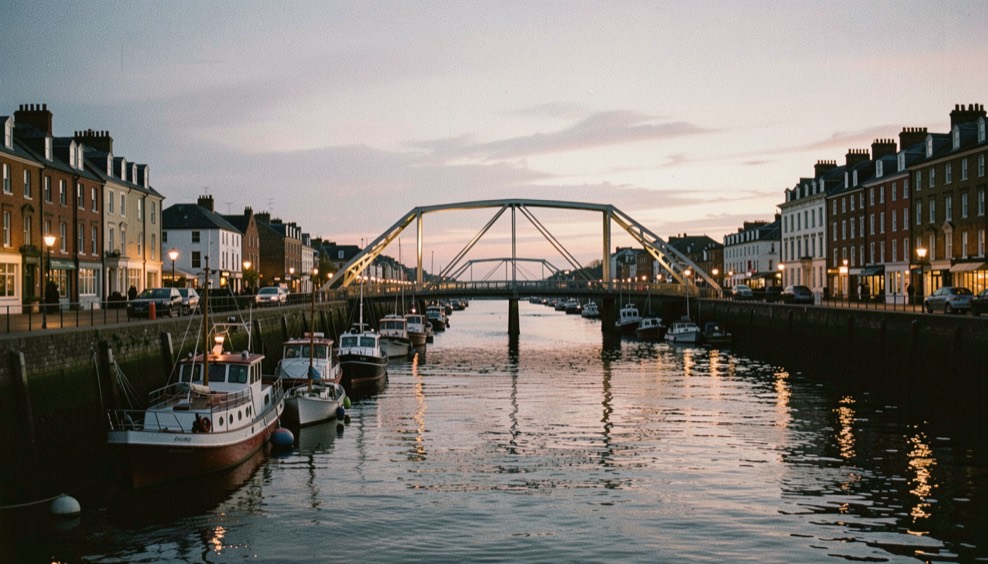
Two days is the span this note works with: one for the harbour, the bridge and the abbey cliff, one for the railway that follows the Esk into the moors. Whitby is small enough for that pace, 13,213 people at the 2011 census, and layered enough that each period can still be read on the ground.
The town stands at the mouth of the River Esk, 47 miles from York and 22 from Middlesbrough, and it has been a bridging point since at least medieval times.
Where does the town begin?
The Saxon settlement was called Streoneshalh, “Streon’s nook of land”. A monastery was founded there in 657 by King Oswiu of Northumbria, after his defeat of Penda of Mercia. It was a double monastery for men and women under its first abbess, the royal princess Hild; the cowherd Cædmon was transformed there into an inspired poet, and the Synod of 664 settled the date of Easter in Northumbria on the Roman reckoning.
Danish raids under Ingwar and Ubba destroyed the house between 867 and 870, and the site lay desolate until William de Percy founded a Benedictine monastery there in 1078. Domesday found the place partially waste in 1086, a decline owed to the Harrying of the North, and recorded the modern name for the first time: Hvítabýr, Old Norse for “Hvíta’s farmstead”. The town’s longer record runs on through fleets, alum and jet.
A harbour cut in two by its bridge
Tolls on the crossing were permitted in 1351. The bridge of 1628 was a drawbridge whose planks were raised by hand; stone posts followed in 1766 at a cost of £3,000, then a four-arched structure between 1833 and 1835 with one swivelling cast iron arch. The present electric swing bridge, built between 1908 and 1909, has a 75-foot (23 m) span and still divides the upper harbour from the lower, about 80.1 acres (32.40 ha).
Each of the grade II listed piers carries a lighthouse and a beacon. The west tower of 1831 is the taller at 84 feet (25.5 m); the east tower followed in 1855 at 54 feet (16.5 m). Both towers and both beacons were fitted with new lights in 2011.
What did the port live on?
Shipbuilding came first. Working in local oak, the yards launched 11,754 tons of shipping in 1790 and 1791, third in England after London and Newcastle. Alum fed the harbour: the rock was processed near Sandsend Ness, three miles from Whitby, and the coal to burn it came by sea from the Durham coalfield.
Whaling paid for much of the Georgian waterfront. The first ship sailed for Greenland in 1753; in the best year, 1814, eight vessels took 172 whales, the Resolution alone yielding 230 tons of oil and 42 tons of whalebone. James Cook learned his trade on the colliers shipping coal from this port, and HMS Endeavour was built here in 1764 and bought by the Royal Navy in 1768. The Monks-haven, launched in 1871, was the last wooden ship; the harbour silted up the next year.
The cliff with the church on it
The east cliff rises 187 feet (57 m) in alternating layers of shale, sandstone and clay above a harbour mouth on a geological fault; the west cliff, boulder clay over sandstone, is the less stable side. St Mary’s Church, grade I listed, keeps its box pews. The road to the East Cliff is long, so the town built stairs: 199 of them, in stone for about two hundred years, with landings where coffin bearers rested. Caedmon’s Trod is the footpath alternative, and the abbey and its stairs have a note of their own.
The West Cliff carries the counterweights of the other trades: a statue of Cook, a whale bone arch, the second of its kind, and, by the inner harbour, William Scoresby Sr, designer of the crow’s nest. The original arch is preserved in the Whitby Archives Heritage Centre. In December 1914 German battlecruisers shelled the town for ten minutes, and the abbey ruin took considerable damage.
Why did the trains nearly stop?
The Whitby and Pickering Railway opened in 1839 with horses on the level and cable on the inclines; Dickens described the experience to Wilkie Collins in 1861:
“In my time that curious railroad by the Whitby Moor was so much the more curious, that you were balanced against a counter-weight of water, and that you did it like Blondin.”
Steam came after the York and North Midland bought the line in 1845; the coast route from Loftus followed in 1883, the Scarborough line in 1885 across the red brick Larpool Viaduct. The Beeching report of 1963 recommended closing all three routes; by 1965 the coast lines and the York link had gone, and only the Esk Valley line survived, kept because the roads were too poor for replacement buses.
Day two, up the Esk
The second day belongs to the valley. The line that survived runs up it through Ruswarp and Grosmont before turning inland to Battersby, six trains a day from Whitby and four on Sundays; the preserved railway has brought steam back from Pickering since 2007.
Weather and stone shape the walking. Onshore winds in spring and early summer bring the sea frets, mists that swallow coast and moor alike; the cliffs belong to a stretch called the Fossil Coast, some 35 miles from Staithes to Flamborough, where dinosaur footprints show on the beach and ammonites, the snakestones, lie in the shale. Jet, compressed ancestors of the monkey-puzzle tree, came in on pack ponies to be worked into mourning jewellery at the trade’s mid-19th century peak.
A port at the mouth of the Esk
Whitby is a seaside town, port and civil parish in North Yorkshire, standing where the Esk meets the North Sea between the moors and a heritage coast. The abbey ruin is its oldest and most prominent landmark; the swing bridge, the listed piers, the whale bone arch and the statues of Cook and Scoresby hold its working past in place. Bram Stoker set part of Dracula in these streets and found the name itself at the old public library.
If fog comes in on either day, stand at the west pier and count. The foghorn there sounds one blast every 30 seconds, and that is the town keeping time.
The town’s layered memory is the subject of the note on keeping local knowledge, and the luck the port lived by is traced in games of chance in a port.